
In staffrooms and educational conferences across Australia, a quiet recalibration is underway. School leaders are auditing screen time, parents are voicing concern over algorithmically driven distraction, and policymakers are scrutinising the lack of measurable movement in standardised assessment scores despite decades of capital expenditure. The initial enthusiasm for digital transformation has given way to a distinct fatigue. In many quarters, the response has been straightforward: pull back, ban devices, and return to paper.
Yet, to understand our current disillusionment, we must first recall what we were actually promised.
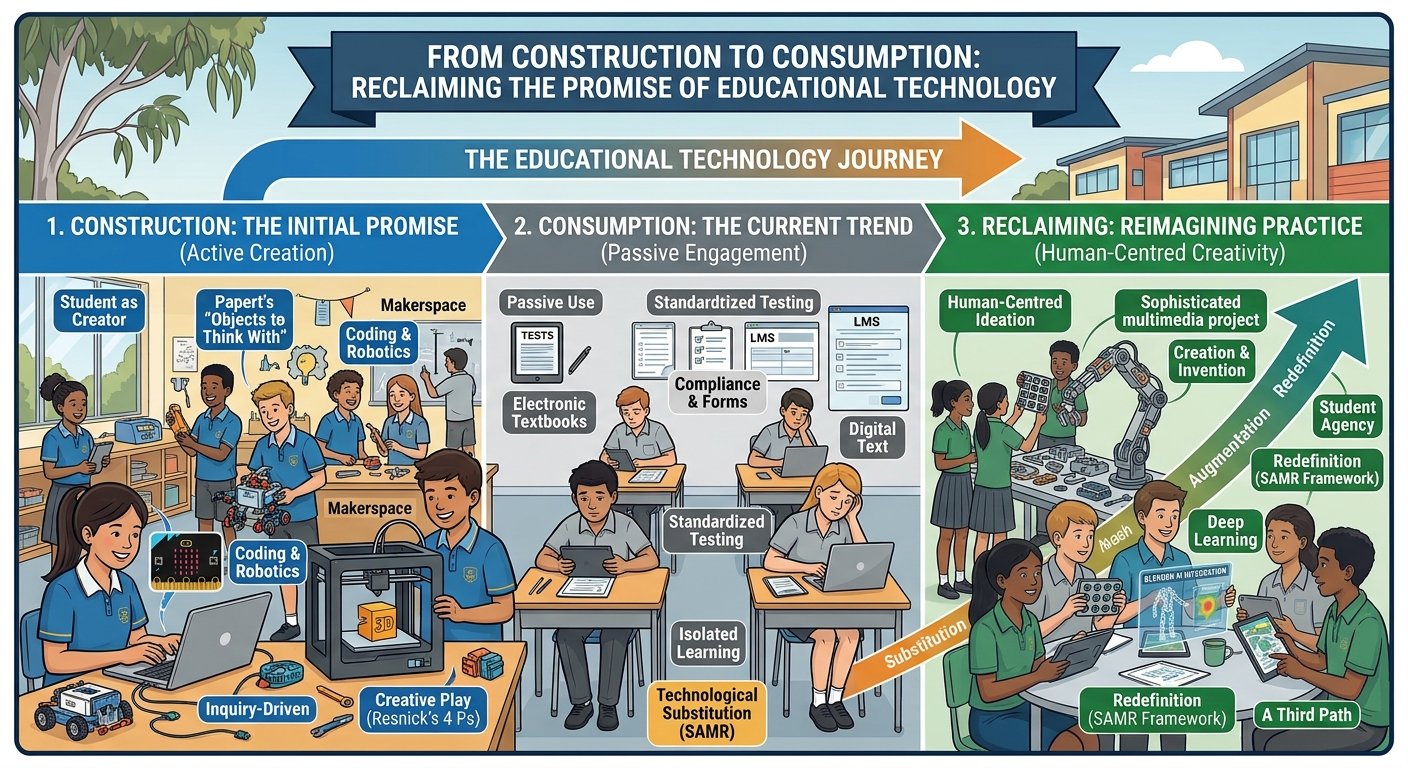
There was a moment when digital technology represented the grandest frontier for authentic, constructivist learning. Grounded in Seymour Papert’s foundational work on constructionism, computers were conceived not as instruction-delivery devices, but as intellectual materials – "objects to think with" (Papert, 1980, p. 11). Technology was going to unlock a world where young people did not merely consume culture, but authored it. Students would design software to address local community challenges, build physical prototypes with 3D printers, record podcasts, assemble digital archives, and collaborate with peers across the globe in real time.
Building directly upon Papert’s vision, Mitchel Resnick and his team at the MIT Media Lab championed an approach to technology that mirrored the creative play of early childhood. Through the Lifelong Kindergarten research group, Resnick demonstrated that when learners engage with digital technologies through the framework of the "Four Ps" – Projects, Passion, Peers, and Play – technology becomes a powerful catalyst for creative thinking (Resnick, 2017). Robotic kits, programmable bricks, and visual programming languages like Scratch were not designed to deliver content; they were designed to give students agency to build, tinker, test, and share physical and digital creations.
"Most people view kindergarten as a stepping stone to the rest of school. We should view the rest of school as a stepping stone to kindergarten." – Mitchel Resnick
This lineage aligned naturally with Sugata Mitra’s self-organised learning environments (SOLE), where children, driven by curiosity and supported by access to digital networks, demonstrated a remarkable capacity to navigate complex questions independently (Mitra, 2012). It was a vision of learner agency, where technology served as a magnifying glass for human curiosity, a platform for physical robotics and invention, and a canvas for collaborative problem-solving.
Somewhere along the way, however, the trajectory bent.
Technology in education shifted from an instrument of creation to a vehicle for consumption. Commercial enterprise software and platform ecosystems gradually displaced open-ended creative tools. Laptops and tablets were subsumed into institutional routines, becoming high-priced electronic textbooks, digital worksheets, and submission portals for static assessment tasks. Learning Management Systems (LMS) established structured, linear pathways designed primarily for administrative surveillance and compliance rather than intellectual exploration. Instead of building robots or programming interactive stories, students found themselves navigating closed digital software suites designed to keep them quietly consuming content in isolation.
This trajectory represents a systemic collapse down the levels of Dr Ruben Puentedura’s SAMR model (Puentedura, 2006). Rather than reaching the upper tiers of Modification and Redefinition – where technology enables task designs that were previously inconceivable – the vast majority of classroom implementation halted at Substitution. The paper worksheet became a PDF form; the physical textbook became an e-reader; the teacher’s whiteboard became a digital display. The technology preserved the traditional architecture of schooling while stripping away the tactile, social, and collaborative dimensions of physical learning environments.
As Yong Zhao has consistently pointed out, forced technological integration often fails because it attempts to automate outdated educational paradigms rather than reinventing the purpose of learning itself (Zhao, 2012). When we treat technology merely as an efficiency tool for traditional direct instruction, we inherit all of its drawbacks – distraction, isolation, and cognitive overload – without capturing any of its transformative power.
We stand at a critical threshold. Education is currently navigating a pendulum swing away from the overzealous, uncritical adoption of digital tools toward an equally rigid retreat. This move mirrors broader structural shifts across Australian schooling: the rise of prescribed, knowledge-rich curricula and the expansion of conventional direct instruction methods. While these approaches can yield short-term gains on standardised assessments, they frequently do so at the expense of deep learning, authentic inquiry, and the cultivation of transferable, lifelong learning dispositions.
Yet now is not the time for despair or passive acquiescence to binary choices.
Those who have long advocated for technology as a catalyst for human-centred ideation, creativity, and student agency must find their voice. The choice facing schools is not a crude dichotomy between total digital prohibition and the vacuous, passive consumption models that have dominated recent years. There is a vital third path: the purposeful, creative deployment of technology as envisioned at the apex of Puentedura’s SAMR framework.
When reclaimed as an instrument for Redefinition, technology allows students to see the world through a fresh lens, to invent, to design, and to solve problems that matter. By moving beyond digital workbooks with added distractions, we can ensure that devices once again serve their original, noble purpose: expanding the horizons of what is possible in the human-centred classroom.
References
Mitra, S. (2012). Beyond the hole in the wall: Discovering the power of self-organized learning. TED Books.
Papert, S. (1980). Mindstorms: Children, computers, and powerful ideas. Basic Books.
Puentedura, R. (2006). Transformation, technology, and leadership. Educational Technology Conferences.
Resnick, M. (2017). Lifelong kindergarten: Cultivating creativity through projects, passion, peers, and play. MIT Press.
Zhao, Y. (2012). World class learners: Educating creative and entrepreneurial students. Corwin Press.