
Despite having spent countless hours in school music lessons as a child, and later engaging with music education as a young student teacher, I must confess that I do not truly understand how music works. I grasp a little of its functional mechanics; I can recall the fundamentals of musical notation, middle C on a stave, and the basic arithmetic of time signatures. I love music deeply, knowing instinctively what moves me and what leaves me cold. I recognise the profound emotional impact that a piece can have, yet I remain largely blind to how that evocative power was engineered by the composer behind it.
Over the years, I have known many people who have learned to play an instrument. Many achieve an enviable level of competence, fluidly performing a learned repertoire of songs. Yet very few of them become musicians in the truest sense. Few reach a point where they can spontaneously rephrase a piece to evoke a different emotional tone, and fewer still transition into composing original works. There is an unmistakable divide between executing a routine of notes and possessing an intuitive, generative grasp of the medium. While performance is certainly not inferior to composition, a gifted performer inevitably brings something of their own human identity, interpretation, and expression to the piece. They do not merely execute a sequence of stored steps; they interpret, reflect, and communicate.
This reality repeatedly draws my thinking back to how we approach the teaching of Mathematics in our schools.
For generations, traditional models of mathematics education have treated the discipline as a rigid catalogue of procedures to be memorised and deployed on demand. We train students to replicate steps, calculate efficiently, and output correct answers under time constraints. Yet, when we reduce mathematics to mere computation, we are teaching human beings to emulate simple machines. A machine excels at arithmetic computation; it stores algorithms and executes them flawlessly without any sense of wonder, context, or meaning. Learning to calculate is not the path to becoming a mathematician, nor is it how one develops into a "Maths Person".
A true "Maths Person" is not an automated calculator. Mathematician James Tanton offers a wonderfully liberating perspective on this identity, reminding us that a simplified definition of a "Maths Person" is straightforward: to be one, you must be a person, and you must do maths (Tanton, 2017). Unfortunately, the current model of mathematics education discourages many people from doing maths or leaves them thinking that maths is simply not for them. Rather, a true "Maths Person" is an inquirer who leverages mathematical understandings to interpret reality, make sense of complex systems, test hypotheses, and solve practical, real-world problems.
If we are to foster genuine mathematical literacy, our pedagogy must align more closely with the teaching of music as an art form and a vital mode of human expression. We must elevate mathematics beyond procedural fluency and aim to nurture thinkers who can "perform" with their mathematical insights.
This shift in perspective is precisely what computer scientist Stephen Wolfram articulated in his provocative TED Talk on teaching mathematics in the age of computers (Wolfram, 2010). Wolfram argues that traditional math education spends roughly eighty percent of its time teaching students to perform hand calculations – the very task that computers can perform instantaneously and flawlessly. By confining students to the mechanical work of computing, we deprive them of the opportunity to engage in the actual conceptual craft of mathematics: formulating meaningful questions, translating real-world scenarios into mathematical models, exploring possibilities, and interpreting results (Wolfram, 2010). When we outsource mechanical computing to technology, mathematics ceases to be a dreary drill of algorithms and becomes a creative, high-level exercise in problem-solving and critical thought.
Our cultural insistence on equating mathematical capacity with algorithmic speed and procedural recall inflicts profound damage on young learners. As Ed Southall observed of his own schooling:
"Mathematics gradually became a mysterious entity, whose rules and steps I was expected to unquestioningly memorise – which I dutifully did. However, the process of storing numerous algorithms and their quirky properties became increasingly tedious, and I fell out of love with the subject that once intrigued and excited me." (Southall, 2017, p. 1)
When we frame mathematics as a dry, sterile collection of rules, even well-intentioned educators who try to make maths "easy" through quick tricks often do their students a profound disservice. They substitute authentic understanding with procedural automation.
In Mathematical Mindsets, Jo Boaler illustrates the folly of measuring mathematical intellect by speed through the story of Laurent Schwartz, the eminent mathematician who was awarded the Fields Medal in 1950 (Boaler, 2016). Reflecting on his school years, Schwartz shared how the pervasive emphasis on rapid calculation led him to doubt his own intellect:
"I was always deeply uncertain about my own intellectual capacity; I thought I was unintelligent. And it is true that I was, and still am, rather slow. I need time to seize things because I always need to understand them fully. Towards the end of the eleventh grade, I secretly thought of myself as stupid. I worried about this for a long time." (Schwartz, as cited in Boaler, 2016, p. 30)
If a Fields Medallist can be made to feel intellectual inadequacy simply because he valued deep, contemplative comprehension over rapid recall, what are we communicating to the millions of children sitting in our classrooms today?
To build a culture of thinking within mathematics classrooms, we must abandon the notion that speed and memory are the hallmarks of competence. Just as we do not evaluate a musician solely by how fast they can play a scale, we must cease evaluating young mathematicians by how quickly they execute an algorithm. We need to create learning spaces where curiosity drives the investigation, where mistakes are examined as rich conceptual data, and where students are encouraged to improvise, generalise, and compose mathematical solutions.
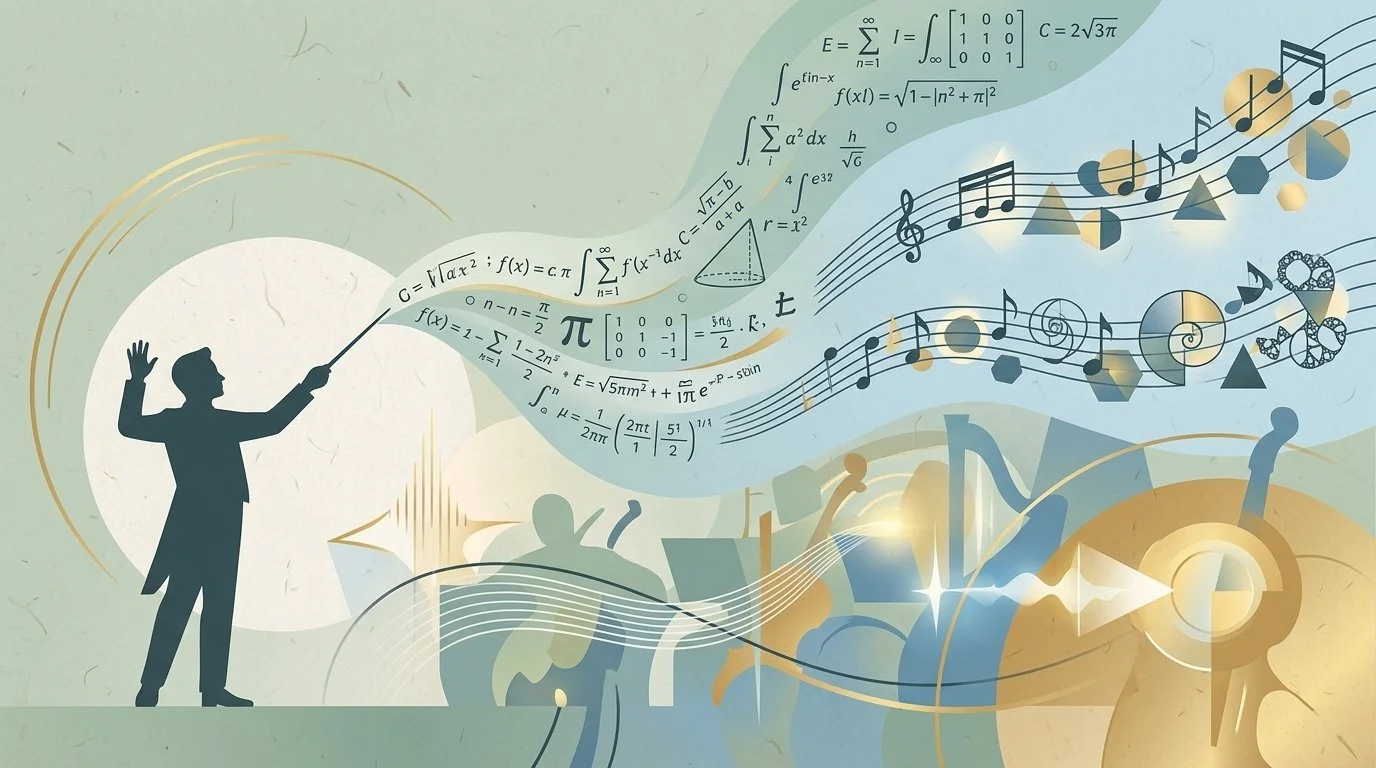
When we treat mathematics as an expressive art, computation becomes merely the notation, while the reasoning, modelling, and creative problem-solving become the symphony. By liberating our students from the role of simple calculators, we invite them to step into their rightful role as thinkers, interpreters, and makers – using the rich language of mathematics to compose a deeper understanding of their world.
References
Boaler, J. (2016). Mathematical mindsets: Unleashing students' potential through creative math, inspiring messages and innovative teaching. Jossey-Bass.
Ritchhart, R. (2015). Creating cultures of thinking: The 8 forces we must master to truly transform our schools. Jossey-Bass.
Southall, E. (2017). Yes, but why? Teaching for understanding in mathematics. SAGE Publications.
Tanton, J. (2017). More joyful mathematics: To be a maths person, you just need to be a person who does maths. Global Math Project.
Wolfram, S. (2010, July). Teaching kids real math with computers [Video]. TED Conferences. https://www.ted.com/talks/stephen_wolfram_teaching_kids_real_math_with_computers