Might now be the time rethink our curriculum?

Our approach to education can at times be baffling. As adults and as parents we reflect on our education and talk about how so little of it ‘stuck’ or is relevant to what we do as adults. We quote Einstein, 'Education is what remains after one has forgotten everything he learned in school.’ and Mark Twain ‘I never let my schooling interfere with my education’ and see in such statements profound wisdom and insights as to the nature of real-world learning. We do this and yet want our children to share the experience of schooling that we had. We marvel at advances in technology and science. Read, occasionally, about advances in brain science and cognition and then agree with politicians and journalists that education should take a 'back to basics' approach. (Bita, N. 2015)

Perhaps the disruption of a global pandemic will prompt a rethinking of how education might be framed to best serve the needs of those who rely on it most? Perhaps now is the time to rethink the curriculum?

As Norman McCulla (2015) writes ‘In opting for narrow definitions of literacy and numeracy and the safe territory of outmoded debates we align ourselves more with a time when the main purpose of schooling was to prepare young people for the burgeoning office work of the Industrial Revolution.’. We cling to dichotomies that present oversimplified images of the options available to educators and debate endlessly direct instruction against constructivist inquiry learning as though one excludes the other and with no recognition that effective teachers pick and choose from a vast toolkit. We ignore that the world is not as it once was and that the jobs we imagine we are preparing our children for will be there when they exit school. We ban students from using the tools they have available thanks to the evolution of technology while as adults relying on these same tools, we insist on basic skills that we never use.

And in this time of a global pandemic, these tools have been forced to the front. We have had little choice but to embrace online learning. With this have come other consequences, a rethinking of how we approach content and how we understand what we want students to learn. What had been a largely private profession built on interactions between teachers and students has been moved into the homes of our clients. This new transparency is forcing many to consider carefully what they teach and how they teach it. There are new levels of uncertainty as we question what we assumed was correct. We are being asked questions about the way concepts are taught and we all have had to accept that we have new teaching partners who had previously been referenced as parents. All of this is encouraging a close looking at the curriculum and how it is taught. What parts of the curriculum matter most, what are the concepts to be mastered and how do we allow the essential dispositions to be learned when they can not be addressed when they are not a natural part of the ‘new’ learning environment?

And then there is our continuing obsession with standardised testing. The importance of achieving positive scores on these tests relies upon the test device measuring aspects of learning that are significant. The reality is that they are both too narrow in focus, measure what is easily measured and are presented in ways foreign to the ways we believe students learn. The consequence is that these tests have an excessive influence on the delivered curriculum students experience as systems place pressures on teachers and schools to perform against these criteria. Should we allow what our children gain from their years of schooling and the manner by which they are taught be shaped by international assessments?

There are alternatives. One possibility is to identify the skills, dispositions and capabilities that our children are most likely to need in their futures. This is not suggested as an abandonment of content, but a reframing of what is viewed as most important. It requires us to rethink what comes first when we plan for and assess learning.

The General Capabilities of The Australian Curriculum

The General Capabilities of The Australian Curriculum

One advantage of a capabilities-driven curriculum is that we can generally agree on a broad set of capabilities, but it is much harder to agree on content, and we must always select what content is covered as there is always more than we have time for. If we move towards a capabilities-driven curriculum, we can allow the content of the curriculum to be adjusted to the needs of local contexts and can be inclusive of student voice. The capabilities, such as creativity, collaboration, communication and critical thinking are adaptable and have utility for engagement with almost all knowledge that might be reasonable to explore in schools. If we wish to move away from a content-driven curriculum where all students engage with the same content at the same time in their learning journey, allowing capabilities to take on the central role is perhaps the best way forward.

The capabilities developed by Partnerships for 21st Centruy Learning

The capabilities developed by Partnerships for 21st Centruy Learning

The possibility of a capabilities curriculum is evident within the Australian curriculum and in other frameworks around the world.  The idea that content might be the vehicle through which broadly relevant capabilities that are likely to play a significant role in the lives that students are likely to live would have a transformative effect on education. As Reid identified in 2005 'the (Australian) curriculum is framed both in terms of the capabilities needed to become autonomous, responsible and productive members of democratic societies, and the procedural principles that will inform the kinds of experiences that will help them to become so.

The challenge of the future is real but now is not the time for despair. Education surely has a central role to play and learning and the dispositions of the learner have greater value now than perhaps ever before. Now is the time for new Renaissance for education not as preparation for an unknown future but as the one constant which flows through our lives and allows us to flourish amidst unceasing change.

 By Nigel Coutts


Bita, N (2015) National primary curriculum shifts focus to core skills. The Australian; August 8 2015

McCulla, N. (2015). The Australian Curriculum: Who are we? Professional Educator 14(1). Melbourne. Australian College of Educators. 8-10

Reid, A. (2005) Rethinking National Curriculum Collaboration Towards an Australian Curriculum Commonwealth of Australia
Insights into the true power of Number Talks

Number Talks are a wonderful way to see where our students are with their mathematical thinking. As a part of a daily routine, a Number Talk promotes number sense and mathematical reasoning. In this post, I revisit what a Number Talk can reveal about our students’ understanding of mathematics, and how they might be used to promote a fresh perspective. In addition, I examine a success criteria for Number Talks that is more expansive and recognises their true power. 

"Number Talks" are an approach to the teaching and learning of Number Sense. Rather than relying on the rote-memorisation of isolated number facts achieved through drills of "table-facts", Number Talks aim to build confident, number fluency, where learners recognise patterns within and between numbers and understand the properties of numbers and operations. Number Talks are a "mind on" learning task that engages students in an active learning process as they search for patterns, decompose and recompose numbers and develop a flexible understanding. It is achieved through direct instruction methods and facilitative dialogue with the teacher or between groups of peers who have had experience with the number talks methodology.  Number talks are all about mathematical reasoning. In place of an emphasis on right answers, we have an emphasis on the rationale for the response. Number talks are most effective when they become one of the routines of a classroom focused on mathematical reasoning and are a great fit with visible thinking strategies. 

Number talks are a valuable classroom routine for developing efficient computational strategies, making sense of math, and communicating mathematical reasoning. A number talk is structured to help students conceptually understand math without memorizing a set of rules and procedures. (Nancy Hughes)

Number talks are:

a brief daily practice where students mentally solve computation problems and talk about their strategies, as a way to dramatically transform teaching and learning in the mathematics classroom. Something wonderful happens when students learn they can make sense of mathematics in their own ways, make mathematically convincing arguments, and critique and build on the ideas of their peers. (Humphreys & Parker)

In a number talk, I am inviting and requiring students to explain their thinking. Mathematical reasoning becomes more important than correct answers. Ask students to solve an addition like 68 + 95 in a number talk and you will know which students understand place value. While participating in the Number Talk students share numerous approaches to each question. They share and hear a range of strategies. Provide students with a whiteboard so they might make their thinking visible and you open new possibilities. Include the option of an extended Number Talk using concrete materials and you allow for diverse representations of mathematical thinking. In each instance, the students are revealing how they understand number and each response offers new insights to the teacher for future learning. Number Talks by design close the gap between student performance and teacher action to address and remediate misunderstandings.

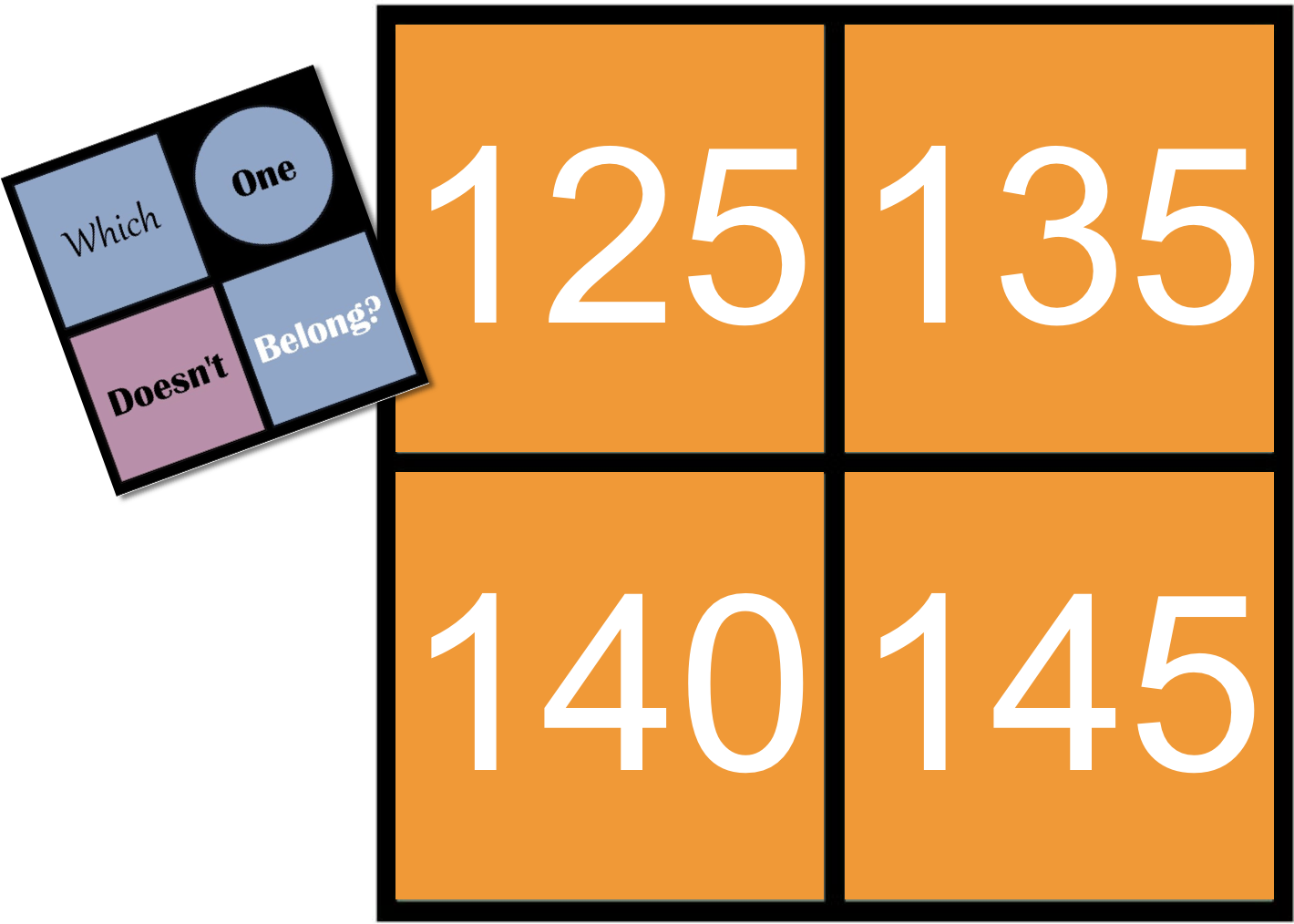
Recently a colleague was engaging her class in a number talk. She had decided to use a “Which one doesn’t belong?” strategy with her class. In this, students are shown a collection of four related items and are asked to nominate one that they feel does not belong in this collection. Thinking is elicited through this strategy when students are asked to justify their choice. She had shared a collection of four numbers: 125, 135, 140, 145 and presented them as in the diagram below. The students were given thinking time and when ready, as indicated by a thumbs-up signal, the teacher invited suggestions. On this day, with this group of learners, suggestions were scarce. After some initial tentative offerings the class began to share with a little more confidence but they never truly picked up on the possibilities. Before the lesson, it had been discussed that the students might identify 140 as the one that did not belong. It was the only multiple of ten, the only odd number, the only number that did not end in a five. Maybe the students would notice that there would be a sequence of numbers increasing by ten from 125 and that the fourth number should be 145. With more mature and capable learners they might have noticed that only 135 is divisible by three. The teacher’s initial reaction was that the Number Talk had not gone well. 

WODB_125_135_140_145.png

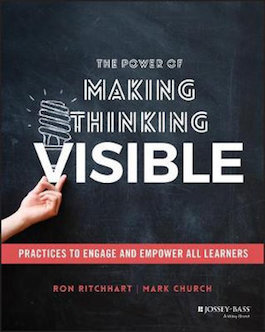
Looked at from the perspective of students demonstrating a high level of mathematical confidence, the session was not great. But this is not the key aim of a Number Talk. A dip into the world of Visible Thinking helps to better understand the value of a Number Talk. In “The Power of Making Thinking Visible”, Ron Ritchhart and Mark Church share the value that thinking routines have and offer the following advice:

Don't judge your success with how smoothly the lesson went. This improves with time. Judge your success by what is revealed about your students' thinking. The question we need to be asking ourselves as teachers after using a thinking routine is: “What have I learned about my students' thinking as a result of doing this routine?” (Ritchhart & Church)

In this instance, the Number Talk revealed much about where the students are with their number sense. Prime amongst the revelations was that they don’t yet have a full understanding of odds and evens and that they are yet to master either multiples of ten or five. The teacher came away with three pieces of useful information and can now develop a strategy to better address each concept. If success is measured by the quality of insights provided by the Number Talk then this was a clear success. 

The success of the Number Talk was further increased by how the teacher reacted, or in this case, chose not to react, as the session revealed gaps in the students’ understanding. The teacher could easily have decided to offer her own suggestions. She might have shared with the students that 140 doesn’t belong because it is an even number or that it is the only one that is a multiple of ten. She could have explained her reasoning to the class, shared some illustrations, referenced a hundreds chart and hoped that the students would have learned the new content. Instead, she allowed the Number Talk to serve its purpose of illuminating for her the current state of her students’ thinking and closed the session. She knew now was not the time to push ahead into direct instruction. She valued the place that thinking plays in Number Talks and refrained from sending a message to the students that in a Number Talk, success is about correct answers. Again, Visible Thinking shines a light on the correctness of the teacher’s choices in this moment. 

Here we must strive to identify when a student's challenge can lead to a productive struggle with the ideas and eventually yield new insights for that student versus when the challenge is overwhelming and likely to cause a student to shut down. (Ritchhart & Church)

In this case, the teacher recognised that the challenge here and the concepts involved were significant and she knows that there will be time in the future to redress these. Just as we create thinking time for our students, we must create thinking time for ourselves. When she does decide to address this content with her students, she will do so strategically. 

The key here is to understand that our teaching can become more powerful when we use the time we have with our learners as opportunities for us to learn more about them as learners. If our singular focus is on teaching content, skills and dispositions we miss the chance to become students of our students, to observe them closely in the acts of thinking and learning and use what we notice to better meet their needs. 

by Nigel Coutts with thanks to Stellina Sim 

Cathy Humphreys & Ruth Parker (2015) Making Number Talks Matter: Developing mathematical practices and deepening understanding. Stenhouse Publishers

Nancy Hughes (2018) Classroom-Ready Number Talks for Third, Fourth and Fifth Grade Teachers. Ulysses Press

Ron Ritchhart & Mark Church. (2020) The Power of Making Thinking Visible: Practices to engage and empower all learners.  Wiley. 

Essential Reading for Teachers Interested in Thinking

If you are interested in building a classroom culture where thinking is noticed, named and celebrated, there are three books which make essential reading. They provide clear evidence for why teachers should focus their efforts on encouraging and normalising thinking and offer research-backed strategies to support this. The books are the result of ongoing research by Harvard’s Project Zero and their lead author Ron Ritchhart. 

Ron has a long teaching history and understands the forces that shape classroom cultures exceptionally well. From his experience in the classroom, he noted that there are particular thinking moves which learners make that support them in developing a deep understanding. He also noted that teachers are able to deploy particular pedagogical moves to foster these thinking dispositions. Since joining Project Zero in 1994, Ron’s research with colleagues Mark Church and Karin Morrison have focused on providing teachers with a better understanding of how they might make thinking visible and build cultures of thinking in their classrooms. This work fits beautifully alongside other projects that sit under the Project Zero banner such as Teaching For Understanding and Agency By Design whose prime goals are well served by the enhancement of thinking dispositions. Indeed the prime belief of Project Zero is that “All Learning is a Consequence of Thinking”. 

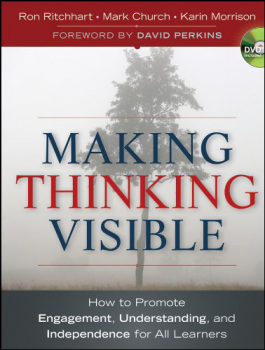
Making Thinking Visible: How to Promote Engagement, Understanding, and Independence for All Learners
by Ron Ritchhart, Mark Church, and Karin Morrison

MakingThinkingVisible.png

This is the ideal starting point for a journey towards a culture of thinking. Readers are introduced to the importance of thinking and the role that it plays in learning. You are introduced to the notion that there are many different flavours of thinking and that we are more likely to effectively navigate the challenges that life presents if we are aware of the thinking required in a given situation. Thinking is unpacked and demystified. With a greater appreciation for thinking as a complex endeavour the value of noticing and naming it is discussed. If we are to teach our students to do something we need to be able to observe how it is occurring and how our teaching strategies are influencing it. While it might be nice to have each classroom fitted with an FMRI machine so we might peer into the functioning minds of our students this is perhaps not practical. Readers of Making Thinking Visible will discover more practical solutions. The book goes on to provide a set of routines that are shown to enhance the quality of thinking that our students engage in during their learning. The thinking routines are easy to utilise teaching tools that have a dramatic effect on your students' quality of thinking. If you find that your students often fail to provide detailed, thoughtful responses to questions, then you will love the effect that a well-chosen thinking routine can have. 

Creating Cultures of Thinking: The 8 Forces We Must Master to Truly Transform Our Schools
by Ron Ritchhart


CreatingCulturesOfThinking.jpg

Once you have read Making Thinking Visible you will most likely become hooked on teaching students to think. You will have explored a variety of thinking routines and have delighted in the new depth of conversation that is becoming the norm in your classroom. As you go along you might notice that some of the points made in the last chapter of Making Thinking Visible are playing a more vital role in your thinking about thinking as you wonder "how do make thinking routine?”. This is where “Creating Cultures of Thinking” steps in as the perfect next read. By this point, you will be ready to move beyond using thinking routines and will want to have thinking become a natural part of your classroom culture. In this book, you are introduced to the eight cultural forces that shape our classrooms. If you want to adjust the culture of your classroom, you will have to confront these forces but how will you do that if you are not aware of what they are. Once you become a master at noticing the eight culture forces at work and make adjustments to how they are experienced in your classroom you will notice that you can indeed shape the culture of your classroom. 

The Power of Making Thinking Visible: Using Routines to Engage and Empower Learners
by Ron Ritchhart and Mark Church

the-power-of-making-thinking-visible.jpg

In this third book, Ron Ritchhart and Mark Church return to the theme of making thinking visible. The authors expand on why making thinking visible is such a powerful strategy and introduce a fresh set of thinking routines. This very recent addition is bound to provide a wealth of new ideas and energise your use of thinking routines. When you are ready for some new approaches to making thinking visible or want to target thinking moves in new ways, this is the book to read. 

And, you might also find this helpful in building an appreciation of why any of this matters.

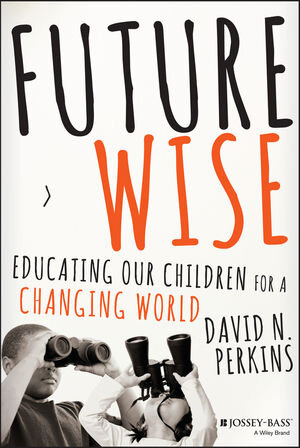
FutureWise.jpg

Future Wise: Educating our Children for a Changing World by David Perkins
How do you answer the 'uppity question’ from a student who wants to know why they need to learn what you are teaching? Do you reply that they need it to do well in the test or are you confident that it is learning they will need to do well in life? In this book Perkins examines what we teaching in schools and makes recommendations for a shift in focus. A key idea introduced early and unpacked throughout the book is the idea of ‘Life Worthy’; learning that is 'likely to matter in the lives learners are likely to live’. Future Wise is jargon free and a great book to share with colleagues, it will help you rethink what you spend time on in class and clarify how you see the role and purpose of education. 


By Nigel Coutts

Might curriculum overloading come from "Idea Creep"

There is a general consensus amongst teachers that the curriculum is overly full. I am yet to meet a teacher who espouses a belief that they have sufficient time to cover all of the material that they are supposed to teach. Part of the challenge here is the ever-expanding breadth of the curriculum as a whole. It seems that as society confronts each new challenge, schools are expected to add a new area of study. Keep an eye for Pandemic Preparedness as an addition to the K-6 Curriculum alongside Coping with Isolation and How to Plan for a Bushfire. It seems that someone in a policy office imagines that school timetables are printed on sheets of rubber and can expand to accommodate each new learning objective. In addition to the breadth of subjects and special interest topics that must be covered, is the great depth of curriculum content that is required in each key learning area. Finding time to cover all of this while engaging the students in meaningful learning, rich thinking and experiences that build understandings are considered the greatest challenges confronting most educators. 

In most instances the claim that the curriculum is overcrowded is valid and indeed this has been backed by multiple studies including an extensive report prepared by the Australian Primary Principals Association (PDF). In response to this, Federal and State Governments have both promised curriculum reviews with the hope of delivering a streamlined curriculum. Internationally the situation is the same as reflected by Singapore’s policy of “Teach Less, Learn More” and the broad interest that this approach has gained.  Whether this curriculum streamlining will target the right content to be culled is certainly open for debate. One response is the typical back to basics approach, which translates into a renewed emphasis on drilling core literacy and numeracy skills. Another approach requires a re-thinking of what learning matters most to students in the lives that they are likely to live. This approach invites a close exploration of the purposes of education and invites an analysis of what's worth learning. 

The tendency to make a leap from the claim that the curriculum is overcrowded to a solution based upon streamlining the curriculum is very natural. One begins to explore questions such as “Why is the curriculum overcrowded?” and “How did it become so overcrowded?” and these are certainly questions that might need to be asked. There is also a tendency to skip another possibility, one that relies on an understanding that there are always multiple curriculums in play. 

Allow me to explain further. There is the curriculum that is intended, the one written by curriculum writers, endorsed by government agencies and published to schools. This intended curriculum is then interpreted by teachers and the result is what might be referred to as the implemented curriculum. It is the implemented curriculum that sits most closely to the experienced curriculum. The interpreted curriculum is what results from the planning process and it is these programmes that teachers subsequently teach from. At this layer, the teacher is blending their understanding of the curriculum with their knowledges of the discipline, of pedagogy and their students. This interpreted curriculum is then delivered to students by teachers who may or not have been involved in the planning process and this leads us to what might be referred to as the experienced curriculum. As implied, the experienced curriculum is that which is delivered to students in the classroom and the interpretation of this curriculum must include the perspective of individual students. Many factors will shape the impact of the experienced curriculum and any interpretation of this curriculum that does not account for individual differences and societal diversity will be flawed. 

When we speak of an overcrowded curriculum we must be clear on which curriculum we are referencing. In many cases, we will be speaking of the intended curriculum and the hope will be that the next version of the curriculum will better meet our needs. This results in a collective finger-pointing and lengthy waiting as we hope for a curriculum that is focused on what matters most according to those who share our beliefs and a fear that those whose beliefs are contrary to this might have more of a say. This mindset results in a belief that the curriculum is beyond a teacher’s realm of influence.

The belief that curriculum overcrowding can only be solved by a shift in policy or an act of government ignores the important part that teachers play in interpreting the curriculum. By shifting our perspective to the interpreted curriculum some level of agency is returned to the teacher. We also begin to see that some of the curriculum overcrowding results from how the curriculum is interpreted and it is worth considering how this process occurs. 

I would like to propose that one cause of curriculum overcrowding is a phenomenon I refer to as “Idea Creep”. Just as a creeper vine grows and takes over more and more space, so too do ideas expand and grow in complexity. This can be seen frequently when one closely compares the requirements for a concept or outcome as defined by the intended curriculum of a jurisdiction with what is implemented. Often one finds that the intention of the curriculum writer has been expanded upon and that content intended for the learners at the next level is introduced early. This tends to be common in mathematics and the sciences and particularly in Primary learning environments. 

It seems that teachers will consider the concept that they are asked to teach and in place of considering how to incrementally build an understanding of this concept dive into teaching all that they know about it. As an example, in the New South Wales curriculum students are gradually introduced to the concept of three-dimensional shape. The curriculum clarifies multiple steps from novice learner to competent mathematician. In Stage One (Years One and Two) students are expected to be able to describe, represent and recognise familiar three-dimensional objects, including cones, cubes, cylinders, spheres and prisms. They need to know the difference between a two-dimensional shape and a three-dimensional shape, use some formal vocabulary, describe which attributes of shapes they used when sorting them, make models of shapes in a variety of means and explain how the models were made. Students at this level do not need to know what makes a cube special, they do not need to know why a triangular-prism is named thusly, they do not need to be able to identify a shape from its net and they don’t need to understand isometric projection. 

A visual interpretation of the NSW Stage One 3D Shape content.

At least some part of the challenge of a bloated curriculum might be resolved if we are able to understand what results in “Idea Creep” and how this might be reduced. Certainly part of the blame for this lies with the manner in which curriculum documents are written. Lengthy introductions, wordy rationales, multiple pages of outcomes and content and all of this written in language that is at best unfriendly to the average time-poor teacher. If a teacher is lucky they may have an hour or two release time to prepare a given teaching programme and are most likely looking after more than one key learning area if they are not singularly responsible for them all. Who can blame a teacher in these circumstances for reading the headline and jumping straight into what they plan to teach? Who in this situation has the time to decipher the code and sort the wheat from the chaff? Part of the challenge also is likely to stem from the need for primary teachers to have expertise across multiple domains, many of which they do not have expertise or significant training in. 

What then might be the solution? Firstly teachers need curriculum documents that are written to be read and interpreted on the fly. Highly visual curriculum documents which clearly identify what needs to be taught and when might ensure “Idea Creep” is minimised. Further, teachers need more time to interpret the curriculum and access to more support in doing so. Spectacular learning experiences are planned for and delivered when teachers are given the time to engage in meaningful collaborative discussion about the curriculum. If the goal is to produce students who have a deep-understanding of the curriculum we also need teachers who have a deep-understanding of it. This understanding is not developed simply from years of experience but from the opportunity to spend time immersed in the curriculum. 

Hopefully an awareness of the dangers of “Idea Creep” will result in a fresh approach to, and broader perspectives on, some of the challenges of curriculum overloading. 

By Nigel Coutts

Maximising student questions in the time of COVID19

In this time of COVID19 and remote learning or emergency distance learning the value of encouraging students to investigate their questions should not be forgotten.

We learn via the questions that we ask and we expand our collective understanding of the worlds in which we live through the questions that we discover. Human knowledge is a historic journey of wonderings that have sparked imaginations and a desire to understand. If there is one thing that separates humans from other species it is our deep-seated desire to understand why things are the way that they are, natural curiosity coupled with the capacity and tools to seek answers.

Our natural curiosity is, however, a fragile thing. Much has been written about the decline of our propensity to ask questions with some sources stating that we peak at age four (Right Question Institute). In 'A More Beautiful Question’ Warren Berger explores this in detail and shows that a confluence of factors including immersion in an environment that feeds learners with facts, a focus on right answers not questions and even low tolerance of questions from educators are at play. Look at the curriculum of any major educational system and you find the knowledge that students are expected to learn as a result of their schooling. From curriculum content come lessons aimed at translating that prescribed subject matter into learner knowledge and the scope for questions is curtailed. Time-poor teachers have little time to cover questions not directly related to the curriculum and even questions related to the content are unlikely to be given much importance as the course materials will by design ensure students encounter the answers whether they are asked or not. 

Curiosity is poorly served by answers. This is a crucial point to understand in this time of remote learning. Undoubtedly our students’ minds will be full of questions at the moment. Questions about the nature of the pandemic, questions about their future, questions about the changes occurring in society and questions about their safety. Beyond this, they will continue to have questions connected to the learning they are engaged in. How we respond to these questions set the tone for how our children will relate to and connect with knowledge. If we provide them with neatly packaged answers they are likely to believe that knowledge is something which is given to you by a more knowledgable other. If we respond instead with questions, prompts and nudges that encourage inquiry we set the conditions for a mindset in which knowledge is gained through a process of exploration, inquiry and investigation. When we encourage our children to self-navigate their way towards answers we enable them as agentic thinkers and set them up as life-long learners.

Great teachers are highly skilled in the arts of facilitating inquiry. They use their knowledge of their learners, their understanding of the subject matter and effective questioning to transform a student’s question into a fruitful investigation. From actively listening to the student’s question they plan their next step. They ask “What makes you think?”, acknowledge the child’s question, share an interest in the search for an answer, suggest a possible starting point. They form a partnership in a search for understanding and through this, the child learns how to learn rather than a quick answer.

The enemy of this style of learning is always time. The temptation to quickly answer the question is compelling for many reasons including some linked to the ego of the respondent, but the most significant obstacle is typically a lack of time. The process of supporting a learner move from nascent question to the framing of a powerful question for inquiry (an essential question of guiding question) and then onwards through the process of investigation and the formation of a conclusion is lengthy. The challenge of time is likely to be even more pressing for parents who are finding themselves picking up the role of the teacher during this time of emergency remote learning. 

'It's the questions we can’t answer that teach us the most. They teach us how to think. If you give a man an answer all he gains is a little fact but give him a question and he’ll look for his own answers. That way, when he finds the answers they’ll be precious to him, the harder the question, the harder we hunt, the harder we hunt the more we learn, an impossible question . . .’  - 'King Killer Chronicles’ by Patrick Rothfuss

The idea of a teacher responding to a students inquiry with a question is one that might be quite foreign to many of our parents. It is likely that their experience of schooling involved the teacher as a source of knowledge. The teacher knew things that they needed to learn and the role of the student was to absorb this wisdom. Teaching was and is seen by many as an act of communication of knowledge from one mind to another. Even if the parent might communicate an understanding that this is no longer the case they may have limited experience with education as a conversation between two inquiring minds. Between a lack of time, a belief that their role as an adjunct educator is to answer questions and limited knowledge of how to foster curiosity with effective questions all means that we may find students missing opportunities for inquisitive exploration. 

Engaging in some creative questioning at home can lead to some wonderful dinner time conversations. "Creative Questions” is a thinking routine for developing ideas and for training your mind to think differently. Instead of responding to a simple question with an answer, the use of some powerful questions can transform the question into an inquiry. Questions like this might help:

  • What makes you say that? or What makes you think that? or How do you know that?

  • What are you trying to do? State your objectives using absolutely no jargon.  

  • What is the problem?  Why is it hard?

  • What questions does that raise?

  • What evidence do you have?

  • What is missing?

  • Where do you go from here?

  • What part of the problem is left?

  • What are you certain about? Why?

  • What would it be like if . . .

  • How would it be different if . . .

  • Suppose that . . .

  • What would change if . . .

  • How would it look different if . . .

This situation is likely to be exacerbated if the learning that we are planning for our students is largely bound to content knowledge. If we are sending home packets of worksheets full of closed questions where there is one correct answer and one well-established method for finding it we create little room for anyone to engage in meaningful inquiry. Now, as always, is a great time for open-ended questions with multiple possible answers and a broad spectrum of approaches to finding a solution. This is also the perfect time to allow students to investigate their questions. In times of such great uncertainty, allocating parts of their week to self-initiated inquiry might be the perfect way to win back a sense of agency. 

What manner of questions should we encourage our students to ask? If we are to encourage out of the box thinking and innovative ideas we must provide opportunities for students to ask questions that connect their interests and passions. If our students are always asking the questions we have imagined for them, or worse still that the textbook writer imagined, when do they get to imagine their own questions? Dr. Richard Curwin explores this in a blog post titled ‘Questions Before Answers: What drives a great lesson?’ Curwin explains the need for lessons centred on a question so engaging to students that it gets under their skin and compels them to inquire. I will argue that the most compelling questions are the great questions our students bring with them.

Consider a typical lesson as a dialogue and then look at this dialogue from the perspective of the teacher and the student. Often it goes something like this: The teacher begins the class either stating or implying that “At the end of this hour you will know . . . or ‘at the end of this hour, you will have discovered x, y & z’. The student hears this and thinks politely to themselves ‘why don’t you just tell me now’ or ‘if I can learn this in an hour how important can it be’ or ponders that favourite of all questions for students to ask ‘why do I have to learn this’.

At the end of the lesson the student does indeed know the new fact or idea, they can parrot back an answer so they must. The teacher is happy and the lesson is deemed a success. At the end of the day the student goes home and answers the question 'what did you do in school today?', they answer ‘not much’ for them the lesson was a failure. Why?  For the student there was no learning, they acquired a new fact but that fact had no value because it was never linked to a question that mattered to them. It was not their question, it did not engage their interest and they just had to play the game to get to the end of the lesson where the fact would be revealed. They knew that the teacher knew the answer, many of the students probably already knew the answer, they certainly could have Googled it, and if they cared they probably would have.

Sometimes we do need to be the person asking the questions, sometimes we need to be the person transferring information; however, the quality of our questions, their power to engage and challenge thinking, combined with the opportunities we provide our students to ask the questions that matter to them are likely to be the times when the most powerful learning occurs.

By Nigel Coutts

Change Management in the time of COVID19

I have written frequently about the question of complexity as it relates to change in educational institutions. It is interesting from a philosophical perspective and it is certainly important to consider how change in an organisation is a result of a multitude of interconnected factors. The potential for reliably predicting the outcome of any change effort is surely difficult, if not even impossible once the number of influences becomes large. Acknowledging the complexity that exists and seeing the potential for growth, creativity and innovation that can exist within an organisation at ‘the edge of chaos’ are useful strategies as schools face a period of unprecedented change. 

It is well known that change is difficult to achieve. A range of research studies cited by Burnes (2010) mention change failure rates of between 60% and 90%, with cultural change initiatives the most likely to fail. We also know that change is typically a slow process. In a recent interview, Tim Brown, CEO of IDEO shared that his experience in supporting organisations to make significant change reveals that he never sees this happen in less than a decade. (Listen Here)

In a previous post, I drew a parallel with the sport of curling. In curling, a heavy polished stone is hurled across the ice towards a target. Competitors running alongside the stone attempt to keep it on course using brooms to gently shape a path for it to follow. I suggested that the organisation is the stone and its trajectory is a result of many factors. The initial force (the origins of the change initiative), the surface of the ice and its interactions with the stone, (the organisation’s total context and the environment in which it operates), the changes made to the surface by the sweepers (the ongoing inputs of the change-makers) all influence how the change will evolve. When we consider this complexity we should not be surprised when our goals are not achieved.

Typically as change agents, we play the part of the curlers, providing the initial force to get things moving and then running frantically alongside making adjustments based on what we see, guided by our judgement of how to best steer the organisation (or stone) in the intended direction. Each little adjustment has an effect, some towards the goal, some in directions we had not intended. Like the curlers, we do not have complete control and we can act only on the basis of what we are able to see and understand about the organisation’s trajectory and the forces influencing it; we act with imperfect knowledge.

Change in education is notoriously slow. Education systems and schools are often compared to the giant seagoing ships in that both take a very long time to change course. If a teacher from 1890 was transported into a classroom of early 2020 they would feel quite at home. The rows or clusters of desks, the board at the front of the room, the teacher’s desk, the books and general paraphernalia of learning would all be there. They would find the routine of the day familiar too. The ringing of the bell, the movement between well-known disciplines, the rush to the playground for lunch breaks would all comfort our time-traveller’s mind. 

But, if our time travelling teacher arrived in many cities of the world today, in April of 2020, amidst the COVID19 pandemic, they would confront a vastly different context. 

Not in years or months but in days, teachers have transformed how “school” works. There has been nothing gradual about this change. It has occurred without any strategic vision. There has been no time to map the change and plan for its impact. No opportunity to develop a coalition of the willing. No one had time for focus groups. There is no plan for today or tomorrow and no plan for the long term. 

At this point in time, the exceptional efforts of educators responding in the moment is allowing education to continue. Students are learning, teachers are facilitating this and the wider community of parents and carers are playing their part. The effort has been superb. The challenge has been huge. The learning curve required for all stakeholders better resembles a cliff than anything else. Most of the structures and routines of schooling that we are all familiar and comfortable with have been transformed overnight. 

COVID19 has taken the rule book on change, torn it into small pieces and thrown most of it out the window. 

For many, the rule book on managing change is Kotter’s seminal work on the topic, “The Heart of Change”. According to Kotter, the change initiative begins with an increased sense of urgency. This is perhaps the one piece of the change model which is clearly evident in the responses to COVID19. Once the decision was made to move from face-to-face teaching to online/remote learning there was a very unmistakable sense of urgency for the change. What might be debated is the need for the level of urgency we have seen. While a move to online/remote learning might be viewed as an unavoidable consequence of school closures in response to the pandemic the immediacy of this might be debated. Could teaching and learning have been put on pause for a week or two to allow a more strategic plan for the long-term delivery of online learning to be devised? Would a longer planning process deliver more effective models for online/remote learning or has the change only been possible because the urgency required an emergency response? Would delaying the process of starting the change result in lengthy delays as systems wallowed in the thick mud that typically inhibits change? 

Kotter emphasises the importance of a vision for change articulated to its audience with clarity and passion. Simon Sinek takes up Kotter’s idea and describes the need for a compelling ‘Why’. A clear reason for why the change should be undertaken that is easily articulated and provides compelling motivation. This vision for change is what motivates action and gives the change effort its direction. In the case of COVID19, the visioning process seems to be catching up with action. We are seeing an emergency response to uncertain and volatile times. Teachers are making the best of what they have and learning new skills to deliver learning to students who have had no preparation for online learning. Families are called on to assist with the management of learning and to act as teachers. The urgency of the response necessitates that this occurs without reference to our vision for what education might be like and what purposes it should serve. In less urgent times a move to online learning would look vastly different. There would be much consideration of how this model might leverage the affordances of technology, maintain connectedness, deliver individualised content, connect learners globally and enhance learning outcomes. Multiple pedagogical models would be debated, curriculum adjustments considered and a clear vision would be articulated. This is yet to happen but must if this is to be more than a short term band-aid. 

The next factor to understand is that individuals are motivated to a large part by the degree of autonomy they believe they have in a situation. Highly controlled, constrictive and micro-managed situations will only result in minimal levels of motivation. A compelling vision delivered prepackaged and with no scope for individualisation will be as morale damaging as any forced change. Edward Deci, Richard Ryan, (2000) and Dan Pink (2009) all show that autonomy motivates. For educators, this is particularly significant as we confront change efforts imposed from above by legislature, curriculum requirements, standardised assessments and it will apply to changes resulting from COVID19. We should predict that there will be many teachers who find the changes required by a move to online learning conflict with their core values. Beyond the initial understanding of the urgency of a response to the pandemic will come a questioning of how this response is evolving. Teachers will want to shape how they deliver online learning and how they engage with their learners. They will seek and expect to be consulted on the models for online learning that are adopted and will want to understand how this aligns with both personal and organisational ideals. Creating space for teacher agency might prove crucial in maintaining motivation beyond the initial weeks of this emergency. 

Lastly, the importance of a sustained and broad effort to sustain the change effort is essential. The most compelling and engaging introduction to a change effort will produce no result if it is not backed by ongoing support and nurturing. Consistent ongoing messaging in alignment with the change effort from every point and every opportunity is essential to building and sustaining momentum. Where the change involves shifts in practices that require staff to operate in new ways appropriate and continual professional development is essential. In this case, there is also a great need to provide support to the entire school community. The success of any model for online learning will be dependent on the level to which it is embraced by all stakeholders. Parents and carers always play an important role in education but this is now elevated significantly. Schools will need to identify opportunities to support all members of this now tightly linked learning community. 

We are only in the early days of this pandemic. It is likely to be a long time before things return to normal. Already people are asking if we will ever return to the way things were. When we stop and reflect upon this period of enforced changes, will there be aspects of the new model that stay with us? What might be the pieces that stick and what parts will we want to rapidly abandon? Will there be parts of the traditional model of education that are revealed as flawed by our experimentation with alternatives? Let us hope that whatever model might evolve out of this time is a consequence of our very best thinking. 

By Nigel Coutts

Burnes, Bernard (2010) Why Does Change Fail and What Can We Do About It?, Journal of Change Management, 10 (2), pp. 241 — 242

Kotter, J & Cohen, D. (2002). The heart of change: Real-life stories of how people change their organisations. Boston, Mass: Harvard Business School Press

Pink, D. (2009). Drive: The surprising truth about what motivates us. New York, NY: Riverhead Books.

Ryan, R. & Deci, E. "Self-determination theory and the facilitation of intrinsic motivation, social development, and well-being”, American Psychologist, 55(1), 2000, p. 68-78.

Responding to COVID19: Now and in the long-term.

The past months and even more so the past few weeks have been challenging for educators on an unprecedented scale. As COVID19 continues to spread both as a global pandemic of a medical nature and as the almost singular focus of social media, education has confronted change on a scale we might never have imagined. Amidst the very real threat to our health and to the safety of our families, teachers have risen to the challenge of reinventing overnight what school is and what it looks like to be a teacher. 

At this point in time, most of us have dove into the deep and murky waters of online learning. For some, this means that all students are working remotely. For others, there is the double challenge of providing for remote learners while also meeting the needs of those who are still attending in person. Some are in lockdown, restricted to their homes and under intense police surveillance, others with varying degrees of liberty. Regardless, we all confront an uncertain future. Timeframes provided by experts vary enormously and it can be hard to see a light at the end of this tunnel. 

"All that was 'normal' has now evaporated; we have entered postnormal times, the in-between period where old orthodoxies are dying, new ones have not yet emerged, and nothing really makes sense." - Sardar, Z. "Welcome to postnormal times”

I have shared this quote from Sardar often, but it seems more real now than ever. There is very little ‘normal’ in the ways we are living our lives, connecting with loved ones, running our households and, for teachers and students, how we are engaging in learning. 

Change in schools is always challenging, but at this point, it seems it is also absolute, unavoidable and urgent. Many educators have been on a slow journey towards models of education that integrate seamlessly with an online world. There have always been those who rapidly embrace technology and those who see it as a threat to their identity or a shiny add-on with little proven value. Now, online learning is very rapidly becoming the norm. This brings with it very real tensions, many of which are yet to be seen in full. These are early days and while teachers are doing an amazing job of learning to swim in this new world of online learning, many will be longing to a return to the modes of teaching they know best. If the need for online learning continues beyond the scope of weeks and extends into months, as many have predicted, we can predict greater challenges. 

Teacher identity is closely linked to our role as teachers and our perception of that role is reflected in our pedagogy. Where the intended change alters the nature of our pedagogy and fundamentally shifts the relationships between teachers and students, and between teachers and knowledge resistance is more likely. Smollan and Sayers indicate the importance of understanding the socially constructed nature of identity and the potentially negative impact that change can have on this for individuals, 'that change ‘dislodges’ identity and leads to anxiety and grieving’ (Smollan & Sayers. 2009 p439) it is difficult to predict how this forced change is likely to impact teacher identity in the long term, however, a degree of grief for what has been lost seems inevitable. 

Educational organisations with their focus on the provision of human services and the inherent relationships between teacher and student and between teachers, creates a complex emotional playground. In schools, emotion and culture are linked, and change of culture frequently invokes an emotional response. “A person’s sense of identity is partly determined by his or her values, which can mesh or clash with organizational values” (Smollan & Sayers 2009 p439) When cultural change is sought in a school and it is not viewed as fitting with one’s values or it calls those values into question emotional responses such as fear, anger or sadness are common. The rapid nature of this change has, at least in many schools and at least in the short term, prohibited the normal processes and norms which accompany significant change. The process of planning, programming and resourcing units of learning, is typically lengthy, involves many stakeholders and much debate. The result, when everything works, is a sequence of planned learning opportunities that are tightly aligned with the teacher’s core beliefs about teaching. Whether this is a belief in the primacy of direct instruction, inquiry-based learning, teaching for understanding, a Reggio Emilia approach or another signature pedagogy, the experiences planned for students by teachers should be in alignment. In the rush to get content online, this process has been derailed and the short-term responses do not reflect the best our profession is capable of, even if they represent an exceptional response under the most challenging of circumstances. 

At some point, we will need to pause. Lift our heads up and survey the scenery in this new world. Then, let us hope that we ask the right questions. Making time and space for a moment of pause and reflection will be crucial if it becomes clear that this is more than a brief fling with online learning. In this moment of pause, we must go back to the fundamental questions that shape our beliefs about learning. These questions should shape how we organise learning in an online world as much as they do when we are teaching face-to-face. 

  • What do I want my students to understand here?

  • What might they already understand about this? What gaps might there be in their understanding? How might I make this visible in an online environment? What obstacles block students from showing their understanding that I can remove? e.g not requiring a written response.

  • What experiences might allow them to achieve this and then demonstrate it?

  • As I evaluate the activities I have planned for my students:

  • Do they move students towards this understanding?

    1. What understanding does this activity require?

    2. What evidence of understanding does this provide?

  • How do I fill gaps? Questions, Prompts, Provocations, Direct Instruction, Feedforward.

  • What thinking will they require for this task? How might I scaffold that? How do I make it visible in an online environment?

  • What next?

And, now perhaps more than ever, as we confront fear and uncertainty, we will all need a sense of agency empowered by capacities required to activate or perform our intentions (Clapp et al 2010). "This entails thinking about the world not as something that unfolds separate and apart from us but as a field of action that we can potentially direct and influence” (Ritchhart p. 77). They must become creative problem finders through learning opportunities that allow them to "sense that there is a puzzle somewhere or a task to be accomplished" (Csikszentmihalyi p. 95) and respond strategically, creatively and collaboratively towards solutions devised with empathy and a long-term view of impacts and real-costs (Kelley). Our students must be shown the value of acquiring deep-understandings through weaving ideas together, going beyond information and figuring things out (Ritchhart).

This demands that our students are routinely engaged with learning that requires them to do thought-provoking things with what they know, such as considering different viewpoints, reasoning with evidence, uncovering complexity and building explanations (Clapp et al) (Blythe). Such complex thinking does not occur automatically, and our students will need to master structures which support this. Visible thinking strategies assist teachers to make deep thinking a routine part of their classrooms and allow them to 'see' the way their learners are engaging with ideas (Clapp et al). All learning is a consequence of thinking and schools must transform themselves into "cultures of thinking” (Ritchhart). This demands a continual evaluation of the culture that is experienced by students and teachers. We must come to value thinking in all its forms and appreciate that our collective futures depend upon the quality of our thinking.

What is most clear to anyone with an understanding of the scale of the challenge educators are confronting is that this is a profession with immense reserves of talent and wisdom. Amidst such great chaos and confronted by a very real threat to their safety, teachers have reinvented what schools look like in a matter of days. Now, we need to be granted the time to step back from the immediacy of our overnight response and plan how we move forward with plans that will best serve the needs of our learners in the longer term. While we hope and pray that we might return to more normal times, the learning that has occurred in the past weeks seems to offer an opportunity too good to be missed. Moving forward this seems like the perfect time to reflect upon what might be the best possible model for education. A chance to restore that which we miss most from our previous models while retaining what we value in the new. 

By Nigel Coutts

Blythe, T. (1998) "The teaching for understanding guide”, San Francisco, Jossey-Bass Publishers.

Csikszentmihalyi, M. (2013) "Creativity: Flow and the psychology of discovery and invention”, New York, Harper Perennial.

Clapp, E., Ross, J., Oxman Ryan, J. & Tishman, S. (2017) "Maker-centered learning: empowering young people to shape their worlds”, San Francisco, Josey Bass

Kelley, D. (2013)  "Creative Confidence: Unleashing the Creative Potential Within Us All”, London, Harper Collins.

[4] Ritchhart, R. (2015) "Creating cultures of thinking: The eight forces we must truly master to transform our schools”, San Francisco, Josey-Bass.

Sardar, Z. (2010) "Welcome to postnormal times”, Futures, 42(5), p. 435-444.

Smollan, R & Sayers, J. (2009) Organizational Culture, Change and Emotions: A Qualitative Study, Journal of Change Management, 9:4, 435-457

Online Novel Study Guide that Encourages Thinking

With many schools moving to online learning around the world I wanted to share a resource that might be of support. One popular option for online or remote learning is the Novel Study. It combines the advantages of encouraging students to read with ease of management and the opportunity to encourage reflection upon what is read. Often this is supported by a set of questions or activities, but they are sometimes very specific to a particular novel and may not require a great deal of thinking. This Novel Study Guide aims to overcome that by linking selected thinking moves to parts of a text. The result is a mash up of thinking routines with close looking at particular features of novels or narrative texts. It is hoped that this approach develops skills which would transfer to other situations where a detailed analysis of a text is desirable.

The site is structured in two ways. You can either begin by selecting a Thinking Move you would like your students to be using (e.g. Reasoning with Evidence or Capturing from the Heart) or target a particular feature of the text (e.g. places, people, events).

The site has been constructed quickly and will continue to evolve. Feedback is welcome using the comments below. You can also download the site as a PDF which allows parts to be copied into other formats.

Access the site HERE

Download The PDF for Text Features

Download the PDF for Thinking Moves

Overview.png

By Nigel Coutts


Desirable Patterns of Learning for Online Learning

With the emerging threat of COVID19 and the closure of schools, teachers are scrambling to move to online learning environments. This will bring with it a myriad of challenges the short time frame is not going to help the situation. While we are fortunate that there are many technological solutions for the provision of remote learning, the more significant challenges will revolve around how we interact with our learners. 

If we believe that “all learning is a consequence of thinking” then we will want to ensure that thinking is required and prioritised in the online learning as much as it is in our classrooms. This might prove challenging but some careful planning should ensure that we do not default to learning that focuses on regurgitation of facts and repeated practice of well-rehearsed methods.

In the face-to-face environment, the relationships that we have built with our students allow us to elicit quality thinking through our dialogue with our class. There is a natural flow of ideas and we enhance this with our use of thinking routines and effective questioning techniques. In an online learning environment, it is easy to break from the good habits we have developed and revert to a role as an expert with answers to provide. 

In the online learning environment, our goal should be to ask more questions and provide fewer answers. 

Assuming we have created opportunities for learning that requires thinking, builds understanding and allows students to develop life worthy dispositions, the next consideration is how will we engage them with this learning. The patterns of learning that are routine in our classroom should not be abandoned as we move online. In the classroom we do not, as a norm, post a task for students to complete and then sit back and wait for completed responses to arrive at our desks ready for assessment. Throughout the process, we engage in the learning with our students. We build in opportunities for questions and we explore incomplete works with our students. As their learning progresses we provide guidance, we nudge them towards deeper understandings and become participants with them in their learning.

The danger in moving to an online learning environment is that this process of learning as a collaborative process between a learner and an empowering educator is broken. A pattern of learning can easily emerge where the teacher sets a task or distributes an activity and the students are expected to complete this with minimal input. Once the task is completed it is submitted for evaluation, the learner moves on to the next task and has forgotten the intent of their initial learning task by the time feedback is received. It is a pattern where there is little to no opportunity for the learner to refine their response while they are engaged in their learning. 

A much more productive pattern of learning is maintained when the learner and teacher utilise the affordances of the online learning environment to enhance opportunities for dialogue. The learner engages in the process of learning, shares initial ideas, poses questions, explores their wonderings. Draft ideas are evolved mutually. Misunderstandings are addressed. The learner understands that incomplete works shared with their teacher will be a foundation for their future learning. The teacher poses questions to the learner, offers prompts and suggestions. The teacher acts as a collaborative mentor who uses information illicit through the online dialogue they maintain with their students to provide adaptive support as it is required.

Taking time to consider the patterns of learning that we desire are important. The choices we make about these patterns should be a guide to both our choice of technological platform and the nature of the online learning that we ask our learners to engage in. If the technology we plan to use does not support the ways we hope to engage with our learners then we should select other tools. 

There will be challenging times ahead, but with some careful planning, we can find new ways to support our learners. As always, we must aim to put learning front and centre and avoid the temptation to keep our students busy during enforced shut-downs.

By Nigel Coutts

The importance of feeling safe in your workplace

It’s interesting how threads emerge from the books we read. An idea springs out at you from one book and then occurs again in another or a link is found between the two. When it turns up a third time in a different place and from an alternate perspective you really take notice. I have had this experience with the concept of emotional or psychological safety. 

It started a while back reading “Creative Confidence” by Tom & David Kelley. Even the title invoked thoughts of what it requires to be creatively confident in an organisation and what the benefits might be. I started to wonder what it would mean if teachers had creative confidence. Would they engage with the curriculum differently? Would they see it more as a guide than a set of directives to be followed to the letter? Might they be more flexible with their pedagogy or more open to change? In “Creative Confidence” the authors describe the restrictive power that a fear of failure has on our creative potential. We might have amazing ideas, but we are not going to try them if we do not feel safe to do so. 

In our experience, one of the scariest snakes in the room is the fear of failure, which manifests itself in such ways as fear of being judged, fear of getting started, fear of the unknown. And while much has been said about fear of failure, it still is the single biggest obstacle people face to creative success. (Tom & David Kelley)

The idea emerged again as I read “Leaders Eat Last” by Simon Sinek. In this he describes importance of feeling safe. “Returning from work feeling inspired, safe, fulfilled and grateful is a natural human right to which we are all entitled and not a modern luxury that only a few lucky ones are able to find.” (Simon Sinek) Once again the idea of feeling safe comes through strongly and with it the need for leadership that values the input of all. In time when workplace stress seems to be endemic, Sinek indicates that “Stress and anxiety at work have less to do with the work we do and more to do with weak management and leadership.” Sinek points to significance of circles of safety within our lives. In organisations, leaders have the responsibility "Only when there’s a strong circle of safety is there innovation. Innovation requires risk, experimentation and failure. If people fear that they might lose their jobs simply because they tried and failed or lost some money then they won’t try so there is no innovation”. Building a circle of safety is one of the most important responsibilities and duties of leadership according to Sinek. "What makes a good leader is that they eschew the spotlight in favor of spending time and energy to do what they need to do to support and protect their people."

The role of safe workplaces came up again while reading “Radical Candour” by Kim Scott. In this book Scott shares insights from the Federal Aviation Authority (FAA). Analysing the causes and details aircraft accidents and incidents is one of the best strategies for finding ways to minimise them. Gathering this information requires honest and open conversations with pilots and airline personnel when something goes wrong but these conversations are not going to occur unless the people involved feel safe. The FAA recognised the importance that safety played and so set up interviews between relevant pilots and retired pilots who were viewed as less threatening than FAA officials. Further, except in cases of careless or reckless actions, pilots were granted immunity from prosecution based on the information they provided. The result is an industry that is constantly learning from its mistakes. 

The final piece of the puzzle comes from “The Fearless Organisation: Creating psychological safety in the workplace for learning, innovation and growth” by Amy Edmondson. What is clear from reading this is that organisations need to be places that promote psychological safety for their staff. Scott writes "I have defined psychological safety as the belief that the work environment is safe for interpersonal risk-taking. The concept refers to the experience of feeling able to speak up with relevant ideas, questions, or concerns. Psychological safety is present when colleagues trust and respect each other and feel able – even obligated – to be candid.” Scott analysed teams of clinicians wanting to understand the conditions that lead to mistakes. She hypothesised that teams with a sense of safety would make fewer mistakes but the results were the opposite. Fortunately, she didn’t abandon her research. What she found was that teams which felt safe were more likely to report mistakes and in doing so were able to learn from them. In cultures that lacked psychological safety, teams hid mistakes and opportunities to learn were missed. 

The takeaway from this is that if we want teachers to openly share their practice, to take risks with fresh ideas, to experiment and innovate, schools need to be places of psychological safety. This requires leadership that extends a circle of safety for all. Teachers need to know that when they try an innovative idea their leaders have their backs and when leaders ask their staff to try new ideas their staff know that they can be honest in their feedback. The circle of safety thrives in cultures that value the input of all and encourages healthy scepticism. 

If the future of education requires innovation and creativity, then we must promote creative confidence and psychological safety. 

By Nigel Coutts

Tom & David Kelley, (2013) Creative Confidence: Unleashing the creative potential within us all

Simon Sinek, (2014) Leaders Eat Last: Why Some Teams Pull Together and Others Don’t

Kim Scott (2017) Radical Candour: Be a kick-ass boss without losing your humanity

Amy C. Edmondson (2019) The Fearless Organisation: Creating psychological safety in the workplace for learning, innovation and growth


Starting a journey towards a culture of thinking

One of the BIG hurdles for teachers wishing to move towards a culture of thinking is the mindset of our students. It is common for students to come to their learning with the belief that school is about memorising information and reciting correct answers. Having to think, reason, make connections and consider different perspectives is for many new and challenging. Some students will want to be told what they need to know. For students who have only experienced a teaching and learning process that emphasises the transfer of knowledge from teacher to learner, being asked to think can feel like being abandoned and left to one’s own resources. They will see it as the role of the teacher to do the thinking, organise the content and explain the connections between ideas. Changing this mindset is the first step.

An excellent place to start is by setting a clear agenda for thinking as an essential part of learning. If the students know that we value thinking, then they are more likely to engage in the process. A core belief linked to this from Project Zero is captured in these words: “All learning is a consequence of thinking.” This involves deliberate attention to the role that the learner’s mind plays in creating schemas which capture and then allow us to utilise learning from the experiences we have. Learning is an active process that requires not only attention in the moment but subsequent cognitive effort as we form, organise and reorganise memories. When we are required to think with and utilise our knowledge in new ways, we make robust memories, and we enhance the interconnectedness of our knowledge base. 

Establishing a culture of thinking requires our deliberate attention to the factors which support this combined with awareness of the more subtle messages we send about learning. These subtle messages we send as teachers and schools play a critical role in this process, and our students learn as much from the culture and language of an institution as they do from the deliberate intent of the lessons provided. A school might have a stated belief in the development of long-life skills but then undermine this by placing an emphasis on test results. According to Ritchart, we teach a lot of very fragile knowledge and content that we know will not stick two weeks after the test. Instead of building a culture that equates learning with work and measures success with test scores, he describes a set of cultural forces that influence attitudes and beliefs about our learning potential and our engagement with it.

Getting Started

Start gently with some accessible thinking routines. A colleague who is a geography teacher broke his teaching and his subject down into three essential questions: 

  • What is there?

  • Why is it there?

  • Who or what cares?

Other disciplines are likely to have their own set of questions. The key here is to identify the fundamental thinking moves and deep questions that our learners will be engaging with. When we begin by asking what type of thinking will our learners need in this situation, the resulting lessons can be framed by this goal. If for instance, I want my students to reason with evidence, I will then build opportunities which require this, use scaffolds that support this and provide feedback on how they have managed this learning. 

In the instance of our geography students, it might be that we want them to make connections with what they know about geographical features while looking closely at an environment they are studying. With this in mind showing students a rich image of an environment and explaining that ‘today we will use a thinking routine to explore this image together’ can be a good start. We might start with “See, Think, Wonder”. The students are invited to look closely at the image and note what is there. As they do so, they share what they think about what they see. In this way, they make connections to prior knowledge. e.g. I see a row of trees and shrubs, I think there must be a watercourse in that area, or maybe this is a planting along a human-made structure like a road. They finish with what questions or wonderings they have and this leads to further exploration. e.g. If there is a watercourse in that part of the image, where does the water go? Who uses it? Why does the land look so dry just a short distance from this line of vegetation? 

If the students are reluctant to notice things in the image, we might try a routine like “Looking Ten Times Two”. In this, they look once at the image and notice ten things. The initial list is likely to include large and mostly obvious features. They write these down. We then show the image again, and they notice another ten things. We can repeat as often as needed. Each time they are forced to look more closely and see more detail. You then use this for discussion around the making of connections. 

Make it Visible so you can talk about it and shape it.

Our use of thinking routines invites students to move beyond knowing and step towards an understanding. If we believe that all learning is a consequence of thinking, we wish to engage students in thinking that aligns with the intent of the curriculum. When we use thinking routines as a scaffold for thinking, our goal is to make the thinking of our students visible. Without a strategy to make the thinking of our students visible, it remains hidden from view. Without access to an FMRI machine, we are not going to see the inner workings of our minds, but we can utilise strategies that shine a light on the process of thinking. We aim to take a very abstract idea of thinking and turn it into a set of steps that can be discussed, shared and shaped. Once we can perceive the thinking of our students, we can reflect on how we might shape this in ways which move them towards the understandings that matter. Our valuing of thinking and our recognition that thinking is both important and challenging allows us to make teaching moves which bring this thinking into the realm of the teachable.

A powerful question: What Makes You Say That?

“What makes you say that?” is a wonderful question that requires our students to explain the thinking behind their responses. The more often you ask this, the better. And making it a routine part of classroom conversation sends a message that we value thinking more than answers. It forces the students to think about their responses and shows you value thinking more than answers. I used to have just the initials WMYST? on the wall and would point to it whenever students made claims or gave answers with no evidence. 

Making thinking routine

One of the very BIG understandings about visible thinking and cultures of thinking is captured by Mark Church “Don’t plan for the thinking routine you are going to use, plan for the thinking you want to make routine”. Our goal is, after all, to make thinking a routine part of our student’s learning rather than to have them do lots of thinking routines. This leads us to wonder about what type of thinking do we want our students to do in this lesson, and what thinking matters most to their learning at this point in time. 

The Understanding Map - Identifying the thinking moves we make routinely

The understanding map is one of the most classroom-friendly resources to evolve from the Visible Thinking project at Project Zero. It was developed from observations of classrooms and thinking in the real world and identifies fundamental thinking moves which we all use frequently. As we plan learning, we might consider what thinking move do we want our students to make. The understanding map helps us identify the thinking moves we will focus on, and gives us a common language with which to discuss this with colleagues and students. By using a common language, we enhance the enculturation of these thinking moves. In the end, when we talk to our students about “Making connections” or “Reasoning with evidence” we want them to have an idea of what this means and why this matters. 

Resources to get you started

If you are wanting to better understand how you might transform your classroom into a culture of thinking or you are looking to make the thinking’s of your students visible, these books are the perfect place to start:

Making Thinking Visible: How to Promote Engagement, Understanding, and Independence for All Learners by Ron Ritchhart, Mark Church and Karin Morrison 

Creating Cultures of Thinking: The 8 forces we must master to truly transform our schools by Ron Ritchhart

And look out for the new Book by Ron Ritchart and Mark Church, “The Power of Making Thinking Visible”.

“We are thrilled to announce the publication of our latest book, The Power of Making Thinking Visible due out in April, 2020. Since Making Thinking Visible was first published in 2011, Mark Church and I have continued to research the use of thinking routines and their impact on learning (we share both qualitative and quantitative data in the new book). At the same time, we have been developing new routines to help structure, facilitate, and enhance learning and thinking. This companion book of new thinking routines draws on the work we have been doing in schools around the world and provides rich examples of the routines in action across multiple grade levels and subject areas. We also articulate exactly why and how the practice of making thinking visible is so powerful for teachers and students.” (Ron Ritchhart)

If your aim is to make thinking routine in your classrooms, you are likely to be seeking the ideal thinking routine to support your students in their thinking. This new site from HGSE Project Zero makes this task easy. In addition to friendly navigation and logical layout, the site includes a number of new routines.

Project Zero’s Thinking Routines Tool 

This tool highlights Thinking Routines developed across a number of research projects at PZ. While Project Zero did not originate the idea of a thinking routine, a vast array of its work has explored the development of thinking, the concept of thinking dispositions, and the many ways routines can be used to support student learning and thinking across age groups, disciplines, ideals, competencies, and student populations. In addition to the initial Visible Thinking research initiative, some of the larger PZ research projects focused on enhancing thinking include Artful Thinking, Cultures of Thinking, Agency by Design, and PZ Connect.


By Nigel Coutts

Celebrating the significance of creativity for educations future success

The past two weeks, I have considered some of the consequences of a world where uncertainty and unpredictable change is the norm. These are “postnormal times” as Sardar describes “Ours is a transitional age, a time without the confidence that we can return to any past we have known and with no confidence in any path to a desirable, attainable or sustainable future.” (Sardar, 2010) There once was a predictable pattern to change; things became predictably larger or smaller, more or less frequent, quicker and easier, swung to the left or swung to the right. Now, this is not the case. Change is fundamental, and the solutions which worked for us in the past, such as our reliance on technology, science and due processes for politics and social understandings are no longer adequate.

In response to this, industry is identifying new skill sets which are considered necessary in these times of uncertainty. Skills such as active learning and learning strategies should be the core business of schools. After all, the fundamental business of education systems from the customers perspective is learning. We often get this the wrong way around and focus on what the teacher does and as such, consider the core business of schools to be teaching. This is like a restaurant that focuses on what the chefs do, cooking, and forget about the experience of the customer, which is dining and the practice of being a diner. If schools get it right, our teachers will do excellent teaching that creates the right opportunities for our students to become learners. Our collective ability to learn and by doing so, adapt to changing circumstances through the acquisition of new skills and dispositions is what Edward de Bono refers to as EBNE; Essential But Not Enough.

The capacity to learn new skills in response to rapid changes is EBNE because in doing, we become dependent upon others to identify and solve the emerging problem for us. Learning in a traditional sense relies upon someone else possessing knowledge and skills that we hope to acquire. According to Daniel Wilson, this model works for traditional problems, even quite complicated ones which are the norm in large systems. Someone somewhere will have experienced this problem before, and there is a solution that is proven to work. The challenge is to identify the problem, find the corresponding solution and apply it in ways that are respectful of context.

But uncertainty means that the challenges we confront have not been experienced before. These complex problems combine challenges from the past with new challenges and new contexts. We can not rely on wisdom from elsewhere as the knowledge we require does not yet exist. We are the first to confront the particular challenges, and we are the first with access to the opportunities that come from solving these in ways which are most responsive to modern times. Learning to learn in these times is, therefore, EBNE, but what then do we need.

Creativity becomes the key path towards solutions to the challenges of uncertainty. According to Tim Brown, past CEO of the design innovation company IDEO creativity is the greatest weapon we have against uncertainty.

“One of the greatest weapons that we have against uncertainty is creativity. It’s how we forge something new out of it.” - Tim Brown IDEO

Creativity is what will allow us to look at the world and see opportunity amidst the chaos of uncertainty. Creativity offers us the fresh perspectives we need, guides us towards new questions and allows novel solutions to emerge. Truly successful individuals will be those who see the world as a place to be interpreted through a creative lens. They will seek out fresh perspectives and challenge the status quo. Organisations will empower their creative individuals by enabling collective and participatory creativity where innovative solutions emerge from truly collaborative processes of ideation.

“The problems of today are too big for one person or organisation to solve alone. We need many people bringing a vast diversity of perspectives to begin to think about old challenges in new ways." - Tim Brown IDEO

Commonly, creativity is seen as a disposition which some people possess and others do not. We see it as a process for individuals and point to the works of those we imagine to be creative geniuses as examples of this process in action. Such an individualistic definition of creativity does not serve us well in times of wide-scale uncertainty. In these postnormal times, no individual will possess all of the information necessary to understand fully and subsequently respond to challenges defined by their complex nature. A more collaborative definition of creativity might better serve our purposes.

Inner Circle - Expertise is the path to solving complicated problemsOuter Circle - Emergence is the path to solving complex problemsSource: Daniel Wilson - @danielwilsonPZ

Inner Circle - Expertise is the path to solving complicated problems

Outer Circle - Emergence is the path to solving complex problems

Source: Daniel Wilson - @danielwilsonPZ

This is what Edward Clapp describes in his book “Participatory Creativity”. In this, creativity is defined as:

“Creativity is a distributed process of idea development that takes place over time and incorporates the contributions of a diverse network of actors, each of whom uniquely participate in the development of ideas in various ways.” - Edward P. Clapp - Participatory Creativity

Such a definition encourages us to see creativity not as the thinking of an individual but as the output of many. Successful organisations will be those that create the conditions which encourage participatory creativity at all levels. The most successful organisations will be those who nurture opportunities for participatory creativity, both internally and externally. Organisations which are closed shops, where ideas are secreted away, where collaboration is curtailed will confront uncertainty through a restrictive lens where alternate possibilities and perspectives remain unseen.

“At IDEO, we’ve worked hard to shift our mindset around uncertainty to one of curiosity and excitement. We value embracing ambiguity—finding the opportunity in the grey space between your comfort zone and the next big idea.” - Tim Brown IDEO

This is the ultimate challenge for schools. Teaching our students to be creative participants is vital for their success, but this too is EBNE. Until schools become places that genuinely encourage models of participatory creativity for every member of their community they will remain doomed to repeat the practices from our past and continue to be surprised when the results thusly achieved do not change.

By Nigel Coutts

What skills might our students most need beyond school?

It is tempting to make predictions of the skills that our students will need beyond their time at school. Such wondering can be a useful guide as we contemplate what we shall focus on with our curriculum. Unsurprisingly, there is no shortage of predictions for future skillsets published by educators, economists and analysts. What might we learn from such lists, and how should education systems respond?

Last week I considered the question of how we prepare for unknown unknowns. Those who seek to gaze into the future are hoping that the conditions we see in the economy and the worlds of work and society today are reliable indicators for the trends of tomorrow. The number of such reports seems to be increasing, and the frequency at which they are updated appears to be shortening. It appears that these are indeed postnormal times when the pace of change is such that predictions of the future have a short lifespan. Sardar describes these “postnormal times” as “Ours is a transitional age, a time without the confidence that we can return to any past we have known and with no confidence in any path to a desirable, attainable or sustainable future.” (Sardar, 2010)

The volatile and unpredictable nature of our current times is reflected in the titles of the research papers which seek to predict how education systems might best respond. The Australian Secondary Principals’ Association (ASPA) commissioned “Beyond Certainty: A process for thinking about futures for Australian education”. Economists, PWC have published a range of articles including “A Smart Move” in 2015 with an emphasis on the importance of STEAM disciplines and more recently “Workforce of the Future: The competing forces shaping 2030” that suggests we may have beyond a STEAM driven imperative. The Foundation For Young Australians (FYA) has published numerous papers with titles such as “The new work basics”, “The new work smarts” and “The new work mindset” emphasising that the world of work is changing for young people and that flexibility in these times of ‘newness’ is essential. A report prepared for the NSW Department of Education on the critical implications for school education of artificial intelligence and other emerging transformations was titled “Preparing for the best and worst of times” playing on the fear and promise of modern times. 

Perhaps the most prolific predictor of future times is the World Economic Forum. On an almost annual basis, they have published a series of predictions for the world of work in the short and near future. These reports show a subtle and consistent shift in the skills predicted to be of most value and the trend is most certainly towards flexible, adaptable skills and lifelong learning. The results of the 2018 “Future of Jobs Report” is summarised in the image below.

Click image to enlarge.

The clear pattern is that the ability to solve complex problems with critical and creative thinking skills continues as do the importance of active learning and learning strategies. If the WEF is right, our young people will need to be analytical thinkers who innovate, understand complex systems and possess emotional intelligence and leadership capabilities. On the decline, by contrast, are skills for memorisation, management, technology use and base skills for reading, writing, math and the darling of so many classrooms “active listening”. 

Skills continuing to grow in prominence by 2022 include analytical thinking and innovation as well as active learning and learning strategies.
World Economic Forum - The Future of Jobs Report 2018

The continued emphasis on the skills of “Active learning and learning strategies” is significant. In times of change, the ability to learn, unlearn and relearn is crucial. This was predicted by Alvin Toffler’s 1970 text “Future Shock” where he wrote:

“By instructing students how to learn, unlearn and relearn, a powerful new dimension can be added to education… Tomorrow’s illiterate will not be the man who can’t read; he will be the man who has not learned how to learn.” (Toffler. 1970 p211)

This is also noted by Professor Alan Reid, the author of the ASPA’s “Beyond Certainty” report who points to the importance of “meta-learning” alongside general capabilities and a contemporary curriculum comprising disciplinary and interdisciplinary learning. Indeed learning is described by Reid as “a key to living in the 21st century”, and an understanding of learning is deemed crucial. 

Meta-learning is the capacity to understand oneself as a learner and the process of learning. It goes beyond metacognition, taking in new understandings about learning in fields as disparate as neuroscience and the functioning of the brain, emotional, sensory and social learning, cognitive psychology, and learning and physical movement. Learning about learning is fundamental in an information/knowledge society where knowledge is expanding at an exponential rate. (Reid. 2018 p6)

By acknowledging the importance of learning to learn and with that the capacity to be self-navigating learners, these reports recognise that the future is assuredly full of unknown unknowns. The best preparation for such a future is to own the capacity to learn and even teach oneself fresh skills on demand. Rather than developing a specific skills set adaptability is the key to success in an ever-changing future, and it is adaptability that PWC describes as “the key to the future”.

One clear lesson arises from our analysis: adaptability – in organisations, individuals and society – is essential for navigating the changes ahead. It’s impossible to predict exactly the skills that will be needed even five years from now, so workers and organisations need to be ready to adapt (PWC. 2018 p31)

What then are the implications for schools? How do we ensure that our students are presented with opportunities to understand how they learn and to take charge of their learning? How do we do this in a culture of standardised testing and an overcrowded curriculum that allows little time for deeply reflective meta-learning as described by Professor Reid? When will our students experience and engage in genuine creative problem solving that requires innovation and critical thinking? Will these be a part of their time in schools or will they be put on hold and first experienced by young people as they enter the world of work?

By Nigel Coutts

PWC (2018). Workforce of the Future: The competing forces shaping 2030. PWC

Reid, A. (2018). Beyond Certainty: A process for thinking about futures for Australian education. Australian Secondary Principals’ Association (ASPA)

Toffler, A. (1970). Future shock. New York: Random House.

World Economic Forum (2018) - The Future of Jobs Report 2018. Centre for the New Economy and Society

Questioning our Assumptions and Considering Multiple Viewpoints

In “Factfulness”, Hans Rosling shares a valuable insight into why we must question our assumptions. In times when we are bombarded with information, when false claims abound, having a disposition towards scepticism seems vital. Rosling urges us to not only question the facts we are presented with but the internal biases which influence how we interpret these facts. 

Rosling shares his personal story of investigating contracts between UNICEF and the big pharmaceutical company Rivopharm for the supply of Malaria tablets. It is common to question the motives of large organisations and pharmaceutical firms are not immune to this. In the particular case that Rosling was investigating, Rivopharm’s bid was significantly lower than what other companies were offering. Clearly there was something going on here and Rosling was suspicious; what was Rivopharm up to? Suspecting that this might be an unreliable, fly-by-night company, Rosling was surprised when he was picked up in a limousine, accommodated in a fancy hotel and taken to a world-class factory. He questioned the manager to determine how Rivopharm could be bidding below the cost of manufacture expecting to uncover some form of scam. 

The truth was more complex. Rivopharm indeed was buying the raw materials from the same suppliers as everyone else and at the same cost. The difference was that they had invested in highly automated manufacturing methods. They could turn the raw materials into packed and ready to dispense tablets in three days. One day later the tablets are shipped to UNICEF and on the same day, Rivopharm gets paid. But Rivopharm has 30 days to pay their suppliers and while the money from UNICEF sits in their banks it is earning interest. Rivopharm makes their profit not directly from the sale of the tablets but from the interest, they make while the money sits in their accounts.

Our assumptions about how the world works shape what we imagine is possible and how we interpret the facts we engage with. When reality doesn’t fit with our assumptions, we are likely to be caught out with thinking that is limited and that opens the door to misunderstandings. 

Our students benefit from strategies that help them uncover complexity and examine multiple viewpoints. One of the most powerful questions we can ask our students is “What makes you say that?”. When we ask this question we invite students to explore and make visible the assumptions that are behind their thinking. The process is valuable for all involved and can help the student better understand their response. In a safe and non-judgemental environment, asking “What makes you say that?” invites reflection and exposes biases or assumptions that prevent us from seeing issues from another perspective.

Here are some other thinking routines which can be useful when confronting the circumstances described in “Factfulness”.

Thinking routines for Uncovering Complexity:

True for Who? - Discuss a given situation thinking about the circumstances of the decision, the people involved, what was at stake, what were the interests and goals of the people involved. Collect this information into a chart and group ideas by points of view. Now use that information to Dramatise the thinking that led to the original decision. Each person uses the chart to respond to three questions:

  • My point of view is . . .

  • I think this claim is true/false/uncertain because . . . 

  • What would convince me to change my mind is . . .

Some group members should observe this dramatisation and then reflect on what they have seen and heard.

Think, Pair, Share - Begin by considering options or responses by yourself. Give this process some time and then share your ideas with a partner. Once you have explained your ideas to your partner and listened to their thinking, share your combined ideas with the larger group. This can maximise the options available to the group and increases the power of many minds working together.

Connect, Extend, Challenge - How are the ideas presented Connected to what you already know? What new ideas are presented that Extend what you know? What is still Challenging you and where does your learning journey go next?

I used to think. . . Now I think . . . (So now I will. . . ) - Use this routine to make visible how your thinking has changed over the course of a learning experience. Then go beyond by describing What made you change your thinking? How did this change occur? What new learning have you achieved?

Thinking Routines Considering Viewpoints:

Circle of Viewpoints - a thinking routine that will help you see diverse perspectives and look at a situation from another person's point of view. Useful in small groups.

  1. Brainstorm a list of different perspectives and then use this script skeleton to explore each one:

  2. I am thinking of ... the topic... From the point of view of ... the viewpoint you've chosen

    1. I think ... describe the topic from your viewpoint. Be an actor – take on the character of your viewpoint

    2. A question I have from this viewpoint is ... ask a question from this viewpoint

  3. Wrap up: What new ideas do you have about the topic that you didn't have before? What new questions do you have? Record your thinking with a mind map, locating differing points of view around a circle.

Here Now/There Then - a thinking routine to encourage thinking about how attitudes and beliefs change over time or from place to place.

  1. Identify an issue that has changed over time or is seen differently from place to place or across cultures

  2. Brainstorm what is known about the issue now and then, how has it changed and what has caused the change. Identify cultural perspectives that make one understanding more true for one culture compared to another.

  3. Ask 'What do I not understand about the other point of view or why things are/were different?' then ask 'How will I find that information?'

  4. Create a comparison chart or Venn diagram to organise your information.

  5. Use this information in a 'Circle of Viewpoints' to help you understand the different perspectives.

Explore other thinking routines here from Project Zero

By Nigel Coutts

Sending the right messages from day one

The start of a new school year brings with it great excitement and just a little sense of panic and chaos. We have new students, new classes, new teachers and new challenges. We spend time getting to know each other and building trust. The first few weeks seem to fly by, and despite our best efforts, we never seem to achieve quite everything we imagined we might. Watch the start of a marathon, and you see a similar scenario as runners jostle position and endeavour to gain an advantage in the first few hundred metres. The start is an explosion of adrenalin and colour as the planning and preparation that has led up to this moment is finally tested. But just like a marathon, the school year is long, and the initial panic of the start is soon forgotten as we enter the second phase between the sprint and the marathon proper.

Now is a great time to focus our attention on the messages we send to our students about the nature of schooling. Hopefully, our students arrive in our classrooms with minds that are open to new learning. They will be excited about the new possibilities that come with new teachers and new classmates. In the opening hours of our year together, we have our best opportunity to establish positive relationships with our students and to connect them with an ideal of learning that will carry them through the year. Our goal is to define with and for our students a grammar of schooling which emphasises the dispositions for learning that truly matter. This concept of a “grammar” of schooling was described by David Tyack and Larry Cuban in “Tinkering Toward Utopia: A Century of Public School Reform”. The idea is that just as our languages have underlying structures which frame how they are experienced, so too does school. Spend enough time in schools and you learn to understand this grammar and come to know what school is about.

The challenge in these opening days, so full of competing pressures, is to identify and then focus on what matters most. What beliefs would we like our students to form about the nature of schooling? Do we want them to believe that success is achieved through critical and creative thinking? Are grit, determination and a growth mindset beneficial dispositions? Is failure a part of the path to learning and is personal growth nurtured by an openness to feedback? Is learning a consequence of thinking and is understanding more valuable than knowing? If these things matter, how do we ensure all of the messages we send to our students align with these goals? As our students enter our classrooms for the first time this year, will they feel safe, nurtured and be expected to bring their best thinking?

It is easy to think of the messages we send as only those which stem from our deliberate communication. When we speak with our students, we generally send messages which align with our goals. Few of us begin the year by telling our students that they must merely show up, that thinking is not required and that a closed mind will be sufficient for success. We don’t emphasise rote learning and a result on a test is not the singular measure of achievement. The “grammar” of schooling is not shaped by our deliberate communication as much as it is by the other messaging systems which are at play. How do we assess student learning, and what do our assessments value? What does the physical appearance of our rooms say about what we value? Are our classrooms inviting spaces where you would want to spend time or are they dry, sterile places that you pass in and out of quickly? How do we respect and honour student learning? Do we celebrate all attempts at learning or only those that result in a correct response? Unless we are deliberate and attentive to all of the messages we send, we are likely to miss opportunities.

While the start is important and we all like to make a positive first impression the second part of the year is ultimately perhaps the most important. It is in this stage that we set up the patterns and routines that will see us through the rest of the year. It is also a time when we begin to understand our learners more deeply and gain a more complete picture of their needs. This is a process that is worth giving time to. Taking a slower, more relaxed approach ensures we make the right choices and ask the critical questions.

For our students, this is the time when they learn to trust us as the guide they will require for the year ahead. Across the days and weeks at the start of each year, they are told what to expected and what is expected of them. Promises are made, and exciting opportunities for learning are outlined. In the coming weeks, they will judge the reality of their experience. Handled well, the result will be students who feel known and trust that their teachers will meet their learning needs; handled poorly and the damage can be hard to undo.

For students new to a school, the next few weeks may be crucial. The initial celebrity that comes with being new has worn off, and friendship circles are rapidly forming about them. Some will negotiate this with ease, but many will find challenges here. This is the time when our pastoral care programmes earn their keep, and a culture of acceptance and inclusion pays off.

The initial weeks of term are likely to be largely teacher-directed as routines are set in place. With this behind us, we can consider the opportunities to ensure the students own the learning that occurs in our classes. The classroom by now will be showing signs of occupation, and the pretty store-bought posters can give way to items produced by the students. Evidence of the learning process will start to show through, and students should be able to have a say in how their learning spaces are constructed and used. Choice in learning is something discussed previously on this site, and it should extend to the way that students interact with the physical reality of their classroom.

Slowing the pace at this point in the year is essential too. The initial panic at the beginning of the year is often a construct of our fear that we have so much to achieve, and so little time to do it. Compared to the students who have just left us this new group naturally seems to require so much; after all they are a full year behind. The desire to fill that gap is natural but will not benefit our students. Taking a step back and identifying each little step towards our goal for the year is important. This is also the ideal time to remind ourselves that learning should be more about the journey than the destination. Our students might need to be ready for high school or final exams or even University in just twelve months time, but they also need to enjoy where they are now with their learning.

For us as teams of teachers, the start of the year also brings new challenges. We arrive back at school refreshed and renewed. Some of us will be new to the school, others will be in new teams, and some will be renegotiating well-known connections. At the start of the new year, a period of ‘storming; within our teams is typical as relationships are tested and negotiated. Beyond this phase comes a somewhat dangerous period of ‘norming’ where team cohesion appears. This can be a time of calm as much of the stress of the initial weeks is put behind us and the team’s natural rhythm surfaces. The danger is that too much cohesion can lead to ‘group think’ where divergent thinking disappears. Effective teams should be able to shift back and forth between divergent patterns of thinking where new ideas explode into possibility and convergent patterns where the best of those ideas are put into place. All members of our learning community benefit from including opportunities to shake things up with some quality divergence and keep teams fresh.

It might be the start of the term that gains headlines but the coming weeks as we shift into marathon mode are just as vital to success at the end of the year. How we use this time, what we value from our students in these weeks, how we engage them in the process of learning and how we put our philosophies of teaching and learning into practice will set a tone that will carry us through the long weeks to come. This year’s journey has begun; now is the time to settle in and enjoy it.

By Nigel Coutts

The folly of goal setting activities

It is soon the start of a new school year for students in Australia. In other parts of the world, the year continues after a short break for Christmas while New Year festivities are just around the corner for those observing the lunar new year. The start of the year is considered an excellent time to reflect on key ideas that matter to our learning and potential for success. But does this equate with goal-setting?

Many students (and teachers) will begin the calendar year with a goal-setting activity. They will take time to reflect in class on what they hope to achieve in the twelve months that follow. They will, for the most part, set achievement goals linked to their academic life, the sort of goals that are achieved through diligent application to classroom learning. They will decide that the way to accomplish these goals is through a commitment to hard work, maintaining focus on the task of learning and effectively managing their time. They will evaluate their success through increases in their assessment results and the hopefully positive feedback that they receive from their teachers. 

In but a few weeks, if not days, these goals will have been forgotten. It is not that the students have lost motivation or have abandoned their hopes for a successful year. It is that the goals set in this way, this structured and forced manner, do not connect with what truly matters to the individuals who set them. 

Our students (and teachers) have learned to play the game of school. We understand its grammar and can interpret its fundamental discourse. School is about getting good grades, pleasing the teacher, providing lots of correct answers and complying with expectations. The goals we set reflect more about our understanding of the nature of school than they do about what we hope to achieve. Very few students share a goal of being creative, thinking outside of the box and disrupting the status quo. “My goal is to express my inner self and explore the questions and wonderings which drive my passion for learning. I will make a dent in the universe” is something Steve Jobs might have thought of sharing with his teachers, but probably didn’t while he was in high school. 

Neurobiology sheds some light on why compliance goals have little real impact in the long term. 

“It is literally neurobiologically impossible to build memories, engage complex thoughts, or make meaningful decisions without emotion. Put succinctly, we only think about things we care about”. (Mary Helen Immordino-Yang, 2016)

“When learning and knowledge are relatively devoid of emotion, when people learn things by “rote” without internally driven motivation and without a sense of interest or real-world relevance, then it is likely that they won’t be able to use what they learn efficiently in the real world”.(Mary Helen Immordino-Yang, 2016)

Our goal-setting should be around the things that matter to us. They should make a bridge between what we must do and what we care about. If we have no emotional connection to our goals, or to the process of setting goals, we are unlikely to truly commit to them. This is largely why new-year’s resolutions don’t stick with us into February, the process is artificial, and the timing of the goal-setting activity could not be worse. We might better use our time planing for the friends and family we hope to connect with over the break as this is what matters to us at this time. We are probably not thinking meaningfully about work, and our students shouldn’t be focussing on school over their break. 

And if we plan to utilise bribery to motivate our students (or ourselves), or if we hope they might identify rewards for achieving their goals, we are likely to be disappointed. Self-Determination theory shows that this type of external motivation has limited impact. 

“Also, research revealed that not only tangible rewards but also threats, deadlines, directives, pressured evaluations and imposed goals diminish intrinsic motivation.” (Ryan & Deci, 2000)

Our goal-setting also falls down because we tend to forget about the things we need to maintain a healthy mind that is ready to learn when we need it to be. Rather than committing to being highly focused and on task at all times, we might need to set goals for downtime. Emerging conceptions of brain functioning reveal that neural networks responsible for maintaining and focusing attention into the environment appear to toggle with a so-called default mode of brain function (DM) that is spontaneously induced during rest, daydreaming, and other non-attentive but awake mental states. (Mary Helen Immordino-Yang) Our brains need to have time to switch off, to relax and do the background processing they require to turn experience into memories. Learning will not occur without this, and so goal-setting that does not include downtime is bound to produce poor results. 

In his book “Start with Why” Simon Sinek writes “Very few people or companies can clearly articulate WHY they do WHAT they do. When I say WHY, I don’t mean to make money— that’s a result. By WHY I mean what is your purpose, cause or belief? WHY does your company exist? WHY do you get out of bed every morning? And WHY should anyone care?” (Sinek, 2011) We are reminded that unless we understand why we do what we do and why it matters, we are likely to lose track of what matters most. We must strive always to be guided towards our “Why” and avoid actions that take us away from this. As Simon Sinek points out that truly successful people and organisations are those who use their “Why” as their north star and never lose sight of it.

The take away might be that if we hope to achieve great things, we are better served by taking the time to reflect on what truly matters to us. If we knew we could not fail, what would we hope to achieve, what would fill us with joy and a sense of purposes achieved? With this clear understanding of our “Why” we can identify the actions, we need to take to transform our dreams into reality. Such a process would have much more transformative than forced goal-setting activities. 

By Nigel Coutts

Immordino-Yang, Mary Helen. (2016) Emotions, Learning, and the Brain: Exploring the Educational Implications of Affective Neuroscience (The Norton Series on the Social Neuroscience of Education) W. W. Norton & Company.

Ryan, R., & Deci, E. (2000) Self-determination theory and the facilitation of intrinsic motivation, social development, and well-being. American Psychologist, 55(1), 68-78.

Sinek, S. (2011) Start with Why: How great leaders inspire everyone to take action. Portfolio Penguin: London

Curiosity, critical thinking and agency as responses to the Australian Bushfire Crisis

The bushfire crisis that is currently impacting Australia is beyond devastating. The scale of these fires defies the imagination. For so long now we have lived with skies laden with smoke as a constant and inescapable reminder that this is not an ordinary summer. This is weather and drought at its most extreme. Our only salvation will be rain but this is not the season for that and the long term forecasts are not promising.

The news coming to us from the areas most impacted by the fires tells a story of heartbreak and loss. Lives have been lost. Countless animals have died what must surely have been cruel deaths. These fires will have pushed many much loved Australian species beyond the brink of extinction. Suffering abounds. There was a time not long past when the loss of one or two family homes to bushfire was newsworthy. This summer the number of families displaced and with no home to return to is in the hundreds and climbing rapidly. Thousands have been evacuated. Many have been forced to escape to the sanctuary of our coastal waters. Day has been transformed into night and the sky turned blood red. This is apocalypse now.

The impact of these bushfires will be felt by all Australians now and for a long time to come. One can not be untouched by the imagery and most will have close personal connections to the people and places directly impacted. Our young people, in particular, will be affected and will need special care in the weeks and months to come. For many, the return to school in early February will be challenging. Many will have been forced away from the communities they call home. Some will have lost loved ones. All will carry emotional scars from the imagery and the environment they have endured over summer. There will be much for schools to do as a support to the healing process. 

Alongside the emotional healing that will be required our students are bound to arrive back in our classrooms with many questions. They will have seen and heard the debate about our collective responses to the bushfire crisis. They will want to understand the connection between extreme climate events and climate change. They will want to know why some people continue to argue against anthropogenic global warming. They will have questions about the response of our politicians to the crisis and want to better understand our political systems. Our students will have opinions on what might be done and what they feel should be done. There will be those who are angry, those ready for a fight, those who are feeling disempowered and many who feel frightened. There will be questions about trust and of what the future might bring. They will want to know what they can do.

A good starting point will be nurturing their curiosity. If our young people become healthy skeptic who challenge claims with wisdom and sound evidence the world will be a better place for all. In these post-truth times when fake news is the new normal, a desire to understand the motivation behind bold claims become a critical life skill. Our children need to have the skills to question and interrogate claims made in the media and to become truth seekers. By helping our students to understand the scientific method and by showing them how science tests and re-tests knowledge we are equipping them with skills that will allow them to confront fake-news head-on. 

The ability to reason with evidence is a thinking move which can be enhanced by the use of appropriate thinking routines. Used effectively and with an understanding of the thinking required in a given situation brings structure to our thinking. Thinking routines bring a degree of order to our thinking that might otherwise be absent and can transform the challenging task of thinking well into a manageable process. When used in the classroom, thinking routines have the added benefit of making the thinking of our students visible. Students can work through the steps of a thinking routine independently or in small groups and capture the thinking which occurs in response to each step for later sharing. The thinking might be captured with pen and paper, on post-it notes or in a digital format. When we make the thinking of our students visible in these ways we create opportunities for further discussion and particularly in the realm of truth-seeking we require our students to reason with the evidence they have gathered. Empty claims are quickly debunked when students are asked to share their reasoning in a culture that values thinking and makes it visible. 

These thinking routines are particularly useful when the aim is reasoning with evidence. Learn more and find other routines here - Project Zero Thinking Routines

  • Connect, Extend, Challenge - How are the ideas presented Connected to what you already know? What new ideas are presented that Extend what you know? What is still Challenging for you about the new topic and/or its connection with prior learning? Use individually recording your responses on paper or in a group with each member responding to the three questions in turn.

  • Think, Puzzle, Explore - Answer these three questions: What do you Think you know about this topic? What questions or Puzzles do you have? How can you Explore this topic? When Exploring begin by looking for ways to expand on what you already know to maximise the benefits of your prior learning.

  • I used to think . . ., Now I think . . . - When you are reviewing a topic take time to include this simple routine. Start with 'I used to think . . . ' then move on to 'Now I think . . .'. Add power by combining with 'What connections are there between the two?'. This routine should help you identify connections with prior knowledge and allow you to identify which parts are entirely new.

  • I see (hear, feel, touch, taste), I think, I wonder - Open your senses to the experience and describe it, give voice to your thoughts as you explore with your senses, finish by asking questions that share what you have sensed and discuss how each sense added to your understanding

  • What makes you say that? - A powerful question for encouraging deeper thinking and one that works best when students learn that this question is not an attack on their thinking but is aimed at revealing more detail.

Armed with curiosity, a desire to seek the truth and the power to reason with evidence, our students will require a strong sense of agency. When we confront frightening and challenging circumstances we have choices to make. If we confront these challenges with a belief that we can influence our individual and collective trajectory, that we might shape our futures we demonstrate positive agency. 

“agency,” is the ability to make choices and direct activity based on one's own resourcefulness and enterprise. This entails thinking about the world not as something that unfolds separate and apart from us but as a field of action that we can potentially direct and influence. - 
Creating Cultures of Thinking - Ron Ritchhart

A sense of agency can be the best defence against the potential to feel overwhelmed and disempowered by the scale of the crisis. Helping our students to realise and act upon their desire to make the world a better place can result in powerful learning. Globally students are finding their voice and speaking truth to power. We need more of this and schools should not stifle this activism. 

In a democratic society where freedom of speech is protected, we are fortunate to have processes through which citizens and their communities can be heard. Helping our students to understand how our political system is structured, how the power of the powerful is managed by laws that protect all citizens is an important part of our role in preparing our students for their tomorrow. Student voice should not be something that is restricted to discussion of matters constrained to the school grounds. Our students will want opportunities to organise and present a collective response to what they have witnessed over this summer. Our students understand that the actions taken or not taken now will have profound consequences for their future and they know that they can not wait until they leave school to have a say in how we respond. 

Perhaps the traditional role of schools has been the maintenance of the status quo. This role might need to be challenged. This is not advocating for teacher activists but it is a likely consequence of a shift in focus from the transfer of knowledge to developing thinking dispositions. As we empower our students to be problem finders and truth seekers, we should expect that they will challenge the “way things are done here”. As our young people challenge the truth of claims made by those in power, it becomes inevitable that schools become the point of origin for their collective voice. If we are genuine in our desire to promote critical thinking, curiosity and student agency, we should not stand in the way of this. 

By Nigel Coutts

You can support the NSW Rural Fire Service by Donating Here

You can support WWF care for injured and displaced animal Here